Rleey | Tungsten Carbide Manufacturing Process Step by Step: Powder to Finished Product
- Share
- publisher
- Jane
- Issue Time
- Oct 11,2026
Summary
This blog walks through the complete tungsten carbide manufacturing workflow, starting from raw WC powder preparation all the way to final finished carbide components. It breaks down each critical production stage including powder mixing, pressing, sintering, blank inspection, precision machining, surface treatment and final quality testing. Readers can learn core technical principles, key quality control points and common defects formed during manufacturing
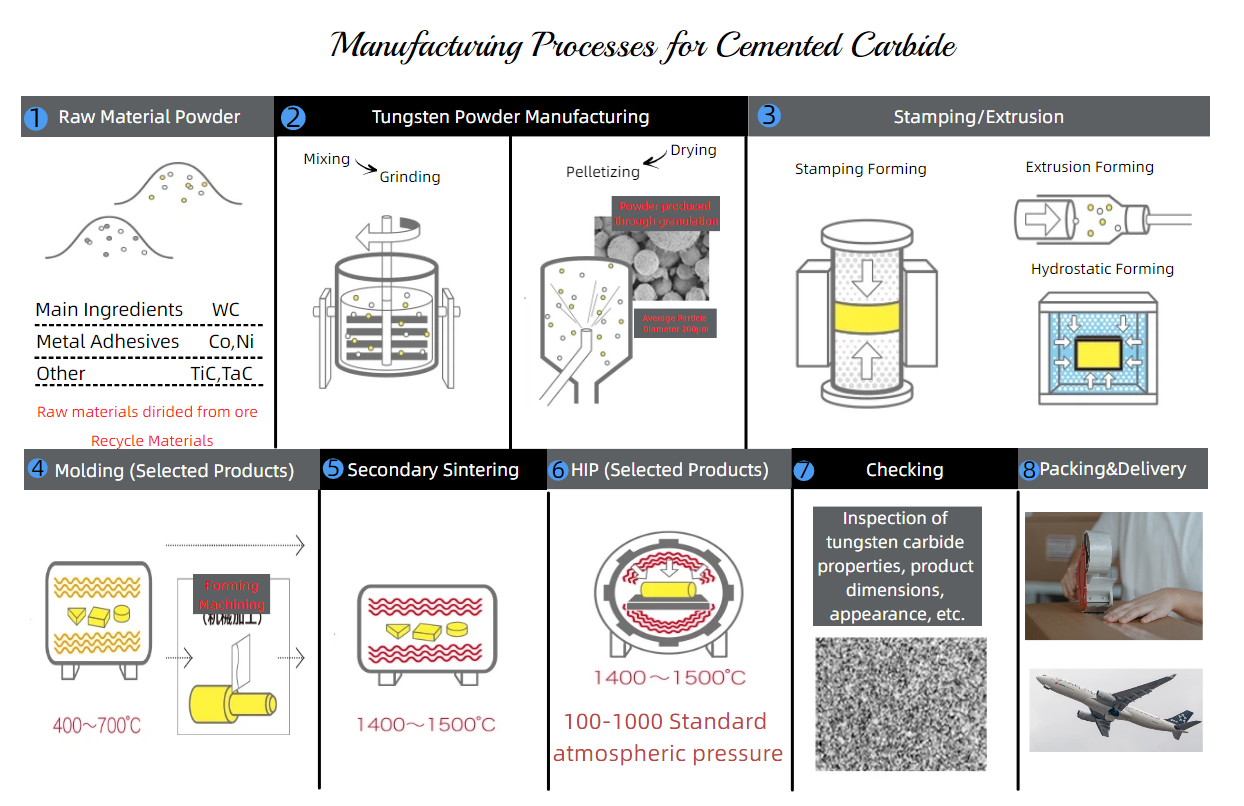
Tungsten Carbide Manufacturing Process Step by Step: Powder to Finished Product
Table of Contents
- Introduction
- Step 1: Raw Powder Preparation & Milling
- Step 2: Granulation & Powder Drying
- Step 3: Compaction / Pressing
- Step 4: Sintering & HIP Treatment
- Step 5: Sintered Blank Inspection
- Step 6: Precision Machining & Grinding
- Step 7: Surface Finishing & Special Treatments
- Step 8: Final Inspection & Shipment
- Common Manufacturing Defects
- FAQ
Tungsten carbide is not cast or forged like conventional metal. It belongs to powder metallurgy material, manufactured by combining tungsten carbide powder with cobalt binder through high temperature sintering. Every step in carbide production directly impacts final hardness, density, toughness, dimensional stability and service life. This step-by-step guide explains the full manufacturing workflow, from raw powder mixing to finished carbide parts. Understanding this process helps buyers judge product quality, understand tolerance limits and make better sourcing decisions for custom carbide components. The starting materials are tungsten carbide powder and cobalt powder. The cobalt percentage determines the material grade and mechanical performance. Powder raw materials are proportioned according to the required grade formula, then loaded into ball mills together with alcohol and grinding media. Poor milling will lead to local cobalt segregation, which creates weak spots inside finished carbide parts. After wet milling, the slurry is dried by spray drying tower to form free-flowing spherical carbide granules. This granulation process is critical for automatic pressing. Good granulated powder flows smoothly into die cavities, guarantees uniform density distribution inside pressed green bodies. If powder granulation quality is bad, the green compact will have density variation, which leads to distortion and cracking during sintering. Granulated powder is filled into precision steel molds and compacted under high pressure to form “green bodies”. Green bodies are fragile pressed blanks with around 50% porosity. They hold shape but have almost no mechanical strength. Two common pressing methods: Pressed green parts are slightly oversized, because the blank will shrink during sintering. The mold size must calculate sinter shrinkage rate accurately. Green compacts go into vacuum sintering furnaces at temperatures around 1400°C to 1500°C. During sintering, cobalt melts and acts as binder, WC particles bond together, and the blank shrinks to reach full density. Many critical carbide parts add HIP (Hot Isostatic Pressing) after sintering. High pressure argon gas eliminates internal micro-pores, improving density and toughness. HIP is widely required for oilfield, cold forging and high-performance tooling carbide components. Sintering temperature, holding time and vacuum atmosphere are tightly controlled. Wrong sinter parameters result in porosity, over-grain growth or brittleness. Once sintering is finished, carbide blanks are inspected before machining: Blanks failing inspection are rejected before investing time on precision grinding. Sintered carbide is extremely hard and cannot be cut with normal cutting tools. All shaping is completed by diamond grinding, wire EDM or laser cutting. Grinding parameters must be carefully controlled to avoid surface residual stress and grinding cracks, which we have covered in previous articles about carbide rod grinding cracks. Based on application requirements, carbide parts get optional surface treatments: The finished carbide components go through full final inspection: Qualified products are packed for global shipment, with proper protection to avoid collision damage during transit. A: It depends on complexity. Standard blanks usually take 2~4 weeks. Complex custom parts with HIP, EDM and multiple grinding processes may take 4~8 weeks lead time. A: Solid tungsten carbide cannot be fusion welded. Brazing is the standard method to join carbide inserts to steel substrates. A: Virgin WC powder has stable particle size and low impurity. Recycled carbide powder is reclaimed from scrap carbide. Recycled material is cheaper but has higher risk of impurity and inconsistent microstructure.Introduction
Step 1: Raw Powder Preparation & Milling
Step 2: Granulation & Powder Drying
Step 3: Compaction / Pressing
Step 4: Sintering & HIP Treatment
Step 5: Sintered Blank Inspection
Step 6: Precision Machining & Grinding
Step 7: Surface Finishing & Special Treatments
Step 8: Final Inspection & Shipment
Common Manufacturing Defects
Defect
Root Cause
Impact
Porosity
Insufficient sintering, poor powder quality
Lower toughness, erosion easily
Sinter distortion
Uneven green density
Dimensional out of tolerance
Grinding cracks
Overheating during diamond grinding
Premature tool failure under load
Cobalt segregation
Inadequate powder milling
Unstable local mechanical performance
FAQ
Q: How long is the total production cycle for custom carbide parts?
Q: Can tungsten carbide be welded?
Q: What is the difference between virgin powder and recycled powder carbide?