Rleey | Match Carbide Performance to Dynamic Industrial Working Conditions
- Share
- publisher
- Bree
- Issue Time
- Oct 10,2026
Summary
Dynamic industrial working conditions require flexible carbide performance. Find out how Rleey tunes tungsten carbide material and geometry to adapt to changing loads and operating environments.
Full Article Structure
- 1. Introduction: Dynamic Working Conditions Challenge Carbide Performance
- 2. What Are Dynamic Industrial Working Conditions
- 3. How Material Grade Alters Carbide Mechanical Performance
- 4. Geometry Adjustment to Adapt to Changing Loads
- 5. Checklist to Match Carbide to Your Operating Conditions
- 6. FAQ for Carbide Under Variable Operating Loads
- 7. Summary & Custom Carbide Performance Tuning
1. Introduction: Dynamic Working Conditions Challenge Carbide Performance
Many industrial applications do not run under fixed, stable loads. Impact force, abrasion intensity and temperature change continuously during operation. Standard carbide parts optimized for static conditions may chip or wear fast when facing variable working loads. Matching carbide performance to dynamic operating environments is critical for stable equipment operation.
2. What Are Dynamic Industrial Working Conditions
Dynamic working conditions refer to operating environments where load magnitude, impact frequency and contact media change over time. Examples include intermittent rock crushing, variable-depth piercing, and equipment that switches between light abrasion and heavy shock during one working cycle.
3. How Material Grade Alters Carbide Mechanical Performance
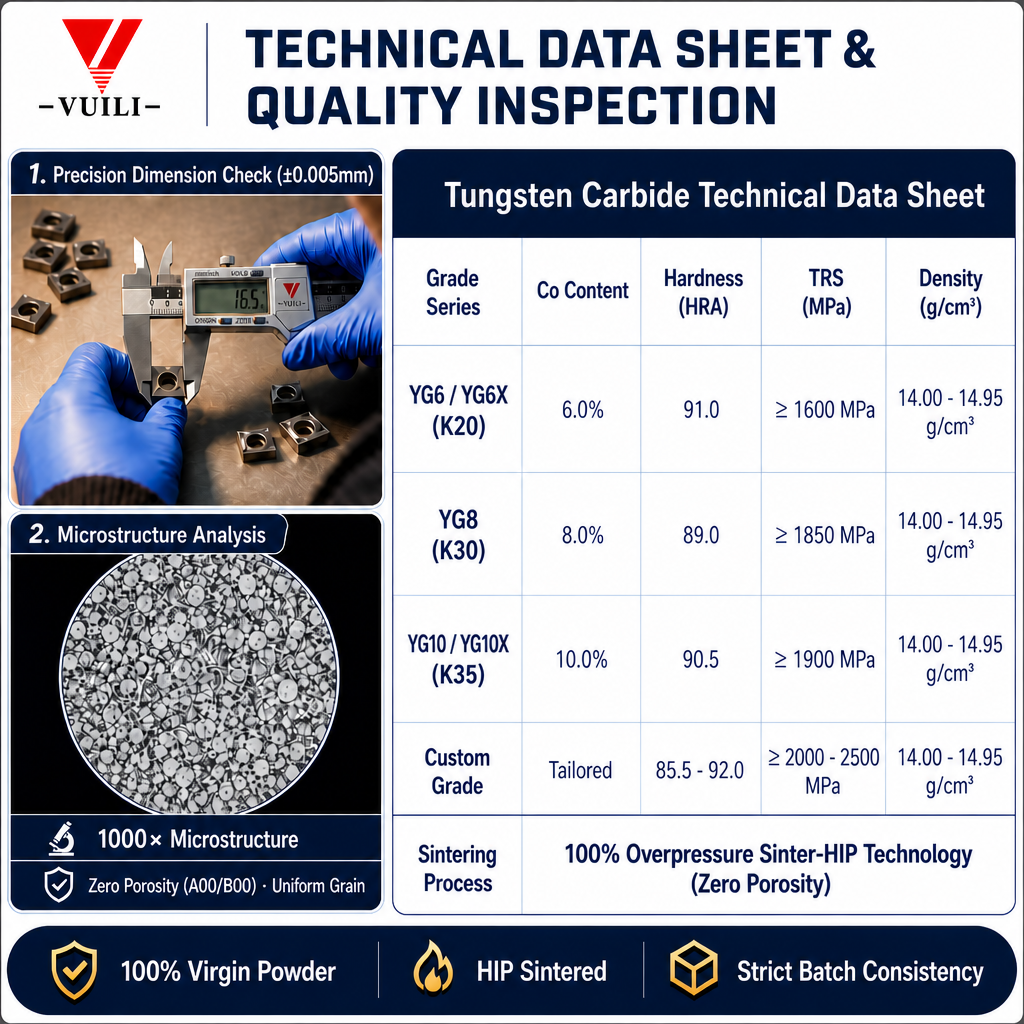
- Low cobalt, fine grain: high hardness for abrasion, lower toughness for shock
- Medium cobalt, medium grain: balanced hardness and toughness for mixed variable loads
- Higher cobalt, coarse grain: excellent impact resistance, reduced wear resistance
4. Geometry Adjustment to Adapt to Changing Loads
Material grade alone is not enough. Part geometry controls stress distribution. Rounded edges, optimized taper angles and fillet transitions reduce local stress peaks when loads suddenly rise. Our engineering team adjusts geometry together with carbide grade to handle dynamic working cycles.
5. Checklist to Match Carbide to Your Operating Conditions
| Working Parameter | What We Evaluate |
|---|---|
| Load fluctuation range | Maximum shock force and normal steady load |
| Abrasive media | Particle hardness, size and concentration |
| Temperature variation | Thermal expansion risk and thermal shock |
| Cycle frequency | Fatigue risk under repeated variable loads |
6. FAQ for Carbide Under Variable Operating Loads
Q1: Can one carbide grade handle both heavy abrasion and heavy impact?
No material can maximize both hardness and toughness simultaneously. We select the balanced grade according to your dominant failure mode.
Q2: How to test carbide performance under dynamic working conditions?
We suggest lab wear-impact testing, followed by field trial samples before mass production.
Q3: Does VUILI support custom carbide geometry for variable loads?
Yes, we can produce custom carbide blanks and finished components with tailored profiles to reduce stress concentration.
7. Summary & Custom Carbide Performance Tuning
Dynamic industrial working conditions require careful matching of carbide grade and part geometry. VUILI analyzes your operating parameters and tunes carbide performance to fit changing working loads. Contact us with your working condition data for technical assessment.
CTA Contact Zone
Carbide Performance Matching Consultation
📧 Contact Us → /contact-us.htm
Share your dynamic load conditions, get carbide grade and geometry recommendation.
Custom Tungsten Carbide Components
📧 Contact Us → /contact-us.htm
Request quotation for carbide parts optimized for variable working environments.
Disclaimer
The content is for general technical reference. Real carbide performance depends on actual site working cycles, media and assembly. VUILI recommends field sample validation before mass production.