Rleey | Tungsten Carbide Grain Size Effects: Fine Grain vs Coarse Grain Guide
- Share
- publisher
- Jane
- Issue Time
- Oct 27,2026
Summary
This article explains how WC grain size changes the hardness, wear resistance, toughness and thermal stability of tungsten carbide. It compares fine grain and coarse grain carbide, lists suitable industrial applications, common mistakes and selection guidance to help buyers specify proper grain size together with cobalt grade for carbide tools and wear parts.
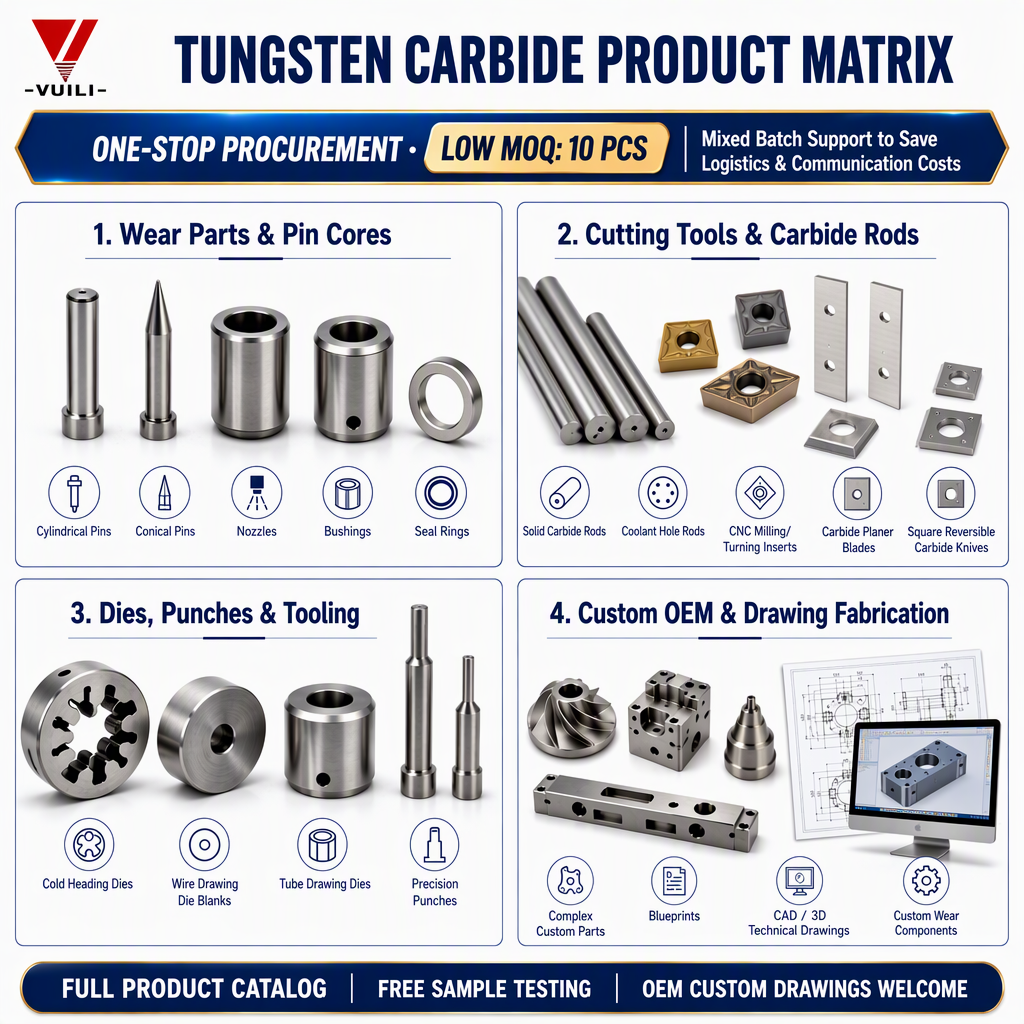
How Does Grain Size Affect Tungsten Carbide Performance? Fine vs Coarse Grain
Table of Contents
- Introduction
- What Is WC Grain Size in Tungsten Carbide?
- Fine Grain vs Coarse Grain Carbide Comparison
- Fine Grain Tungsten Carbide: High Hardness & Edge Retention
- Coarse Grain Tungsten Carbide: High Toughness & Thermal Resistance
- Medium Grain Carbide: The Balanced Standard Option
- Practical Selection Rules: Grain Size + Cobalt Content
- Common Misunderstandings About Carbide Grain Size
- FAQ
Introduction
Most buyers only check cobalt content when ordering tungsten carbide, but WC grain size is another core variable that changes performance dramatically. Even with the same cobalt percentage, fine grain and coarse grain carbide will show big differences in hardness, edge stability, abrasion resistance and crack resistance.
Grain size describes the average particle size of tungsten carbide crystals inside the sintered alloy. Manufacturers classify carbide as fine, medium, coarse and extra-coarse grain grades. Adjusting grain size is a key way to tune carbide beyond simply changing cobalt binder.
If you specify only YG6 or YG8 without grain size control, you may receive parts with inconsistent service life. This guide clarifies the performance tradeoffs and matching use cases.
What Is WC Grain Size in Tungsten Carbide?
Tungsten carbide is a composite of WC hard grains and cobalt binder. After powder mixing, pressing and sintering, WC grains form a continuous hard skeleton wrapped by cobalt phase.
Grain size is measured in micrometers (μm). Typical classification ranges for conventional WC-Co carbide:
- Fine grain: 0.2 ~ 0.8 μm
- Medium grain: 0.8 ~ 2.0 μm
- Coarse grain: 2.0 ~ 5.0 μm
- Extra-coarse grain: >5.0 μm
Grain size can be verified through metallographic inspection, which is why metallography is a mandatory QC item for high-spec carbide components.
Fine Grain vs Coarse Grain Carbide Comparison
| Property | Fine Grain Carbide | Coarse Grain Carbide |
|---|---|---|
| Hardness (same Co%) | Higher | Lower |
| Abrasion Resistance | Superior for fine abrasive wear | Good for heavy abrasive, high heat |
| Edge Sharpness & Edge Holding | Excellent, sharp stable cutting edge | Harder to get ultra-sharp edge |
| Impact & Crack Propagation Resistance | Lower; easier to form microcracks | Higher; better resistance to crack spread |
| Thermal Shock Resistance | Moderate | Better |
| Brazing & Heat Tolerance | More sensitive to brazing thermal shock | More tolerant to heating cycles |
Note: This comparison assumes identical cobalt content, density and HIP treatment. Grain size effect works together with cobalt ratio.
Fine Grain Tungsten Carbide: High Hardness & Edge Retention
With tiny WC grains uniformly distributed, fine grain carbide achieves higher hardness at the same cobalt level. The dense fine microstructure supports extremely sharp cutting edges and resists micro-chipping on the cutting lip.
Best Applications
- PCB micro drill blanks, precision solid carbide rods
- Fine slitting blades, wood cutting knives requiring long edge life
- Wire drawing dies for fine copper and steel wire
- Small precision punches, gauge pins and measuring wear parts
- Cutting tools for low-impact, high-precision continuous machining
Limitations
Fine grain carbide is more sensitive to impact and thermal shock. Under heavy percussion or cyclic heating, microcracks can quickly expand and cause edge failure. It is not the first choice for rock buttons or heavy cold forging dies.
Coarse Grain Tungsten Carbide: High Toughness & Thermal Resistance
Coarse WC grains slow down crack propagation. When a crack starts, it needs to travel around large WC grains, which absorbs energy and stops rapid fracture. Coarse grades handle high heat and cyclic shock much better.
Best Applications
- Rock drilling buttons, mining percussion inserts
- Large carbide wear plates under heavy abrasive impact
- Heavy cold forging dies and big punch cores
- Roller skins, crusher teeth and parts with high thermal cycling
- Oil & gas downhole wear components with vibration load
Limitations
Coarse grain carbide cannot hold ultra-fine sharp edges. It tends to develop rounding faster in fine abrasive cutting, so it is not suitable for precision slitting and micro cutting tools.
Medium Grain Carbide: The Balanced Standard Option
Medium grain carbide sits between fine and coarse, and it is the most common default grade for YG6, YG8 general-purpose products. It balances edge performance, wear resistance and crack resistance, suitable for most standard wear parts and cutting strips.
When buyers do not specify grain size, most carbide factories supply medium grain stock. It is safe for woodworking strips, general shredder blades and conventional wear liners where requirements are not extreme.
Practical Selection Rules: Grain Size + Cobalt Content
Grain size and cobalt content work together; you cannot judge performance by only one factor. Here are simple combinations:
- Fine grain + low cobalt (YG6): Highest wear resistance, sharp edge for low-sharp precision cutting
- Medium grain + medium cobalt (YG8): All-round choice for most wood cutting and wear parts
- Coarse grain + high cobalt (YG15): Maximum impact resistance for forging, drilling and heavy mining
If your part fails by edge rounding: move to finer grain. If your part fails by cracking: move to coarser grain or higher cobalt.
Common Misunderstandings About Carbide Grain Size
- Mistake 1: Finer grain is always better. Fine grain improves edge life but sacrifices impact resistance. It will fail quickly under shock.
- Mistake 2: Same grade name means same grain size. YG8 from different factories can be fine, medium or coarse grain, leading to inconsistent results.
- Mistake 3: HIP changes grain size. HIP removes pores and improves density; it does not change the original WC grain size classification.
FAQ
Q: How do I verify carbide grain size before bulk order?
A: Ask for metallographic inspection report. Lab technicians prepare samples, etch the surface and measure grain size under optical microscope.
Q: Can fine grain carbide be used for cold forging?
A: Only for light, low-impact cold forming. Heavy repeated impact will cause cracking, coarse grain high-cobalt grade is preferred.
Q: Does grain size affect EDM and grinding processing?
A: Fine grain carbide can achieve smoother surface finish after grinding and EDM. Coarse grain carbide may leave more visible surface texture after finishing.