Why As-Sintered Carbide Pointed Pins Are Preferred for Low-Cost Industrial Piercing Projects
- Share
- publisher
- Bree
- Issue Time
- Oct 6,2026
Summary
As-sintered carbide pointed pins eliminate expensive post-sinter grinding operations, cutting total part cost for industrial piercing applications. This article explains when as-sintered blanks meet piercing requirements and their cost advantages for mass production.
Full Article Structure
- 1. Introduction: High Machining Cost Is a Pain Point for Piercing Tooling
- 2. What Are As-Sintered Carbide Pointed Pins
- 3. Why As-Sintered Pins Fit Low-Cost Industrial Piercing
- 4. VUILI Production Process for As-Sintered Carbide Pointed Pins
- 5. Application Scenario & As-Sintered Pin Matching Table
- 6. FAQ About As-Sintered Carbide Piercing Pins
- 7. Summary & Low-Cost Piercing Pin Service
1. Introduction: High Machining Cost Is a Pain Point for Piercing Tooling
Many industrial piercing projects require large batches of carbide pins. Full grinding and polishing after sintering greatly raises unit cost. As-sintered carbide pointed pins keep the near-net shape directly after sintering, removing most secondary machining work. This solution maintains enough hardness and wear resistance for standard piercing while cutting total expenditure.
2. What Are As-Sintered Carbide Pointed Pins
As-sintered carbide pointed pins are formed by powder compaction and one-time sintering. The final geometry including the pointed profile is formed during pressing and sintering, without heavy post-process grinding. Surface retains natural sintered texture, and material properties are identical to fully ground carbide parts of the same grade.
3. Why As-Sintered Pins Fit Low-Cost Industrial Piercing
- Near-net shape forming: cuts expensive grinding and polishing labour
- Consistent material hardness and wear resistance after sintering
- Suitable for mass production and fast delivery for bulk piercing orders
- Lower minimum order quantity for small and medium piercing projects
4. VUILI Production Process for As-Sintered Carbide Pointed Pins
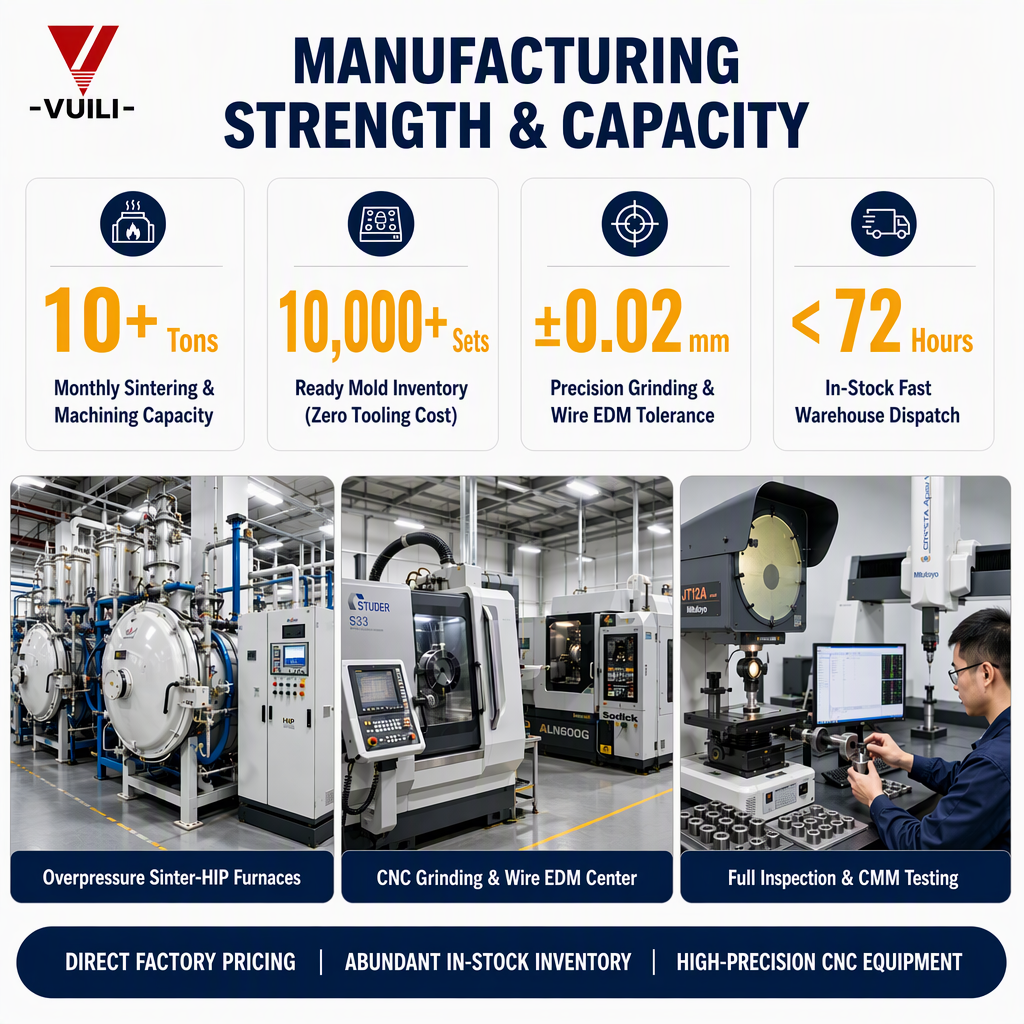
We design custom moulds to press the pin profile including the pointed tip. Green compacts go through low-pressure debinding and high-temperature sintering. We inspect dimensional tolerance, density and hardness after sintering. No extra grinding is needed for qualified as-sintered pins ready for piercing work.
5. Application Scenario & As-Sintered Pin Matching Table
| Piercing Application | Recommended Pin Type | Cost & Performance Advantage |
|---|---|---|
| Low tolerance plastic film piercing | As-sintered carbide pointed pin | Great cost saving, sufficient wear resistance |
| Medium thickness non-metal sheet piercing | As-sintered pin with minor edge honing | Balance of low cost and stable piercing life |
| High precision thin metal piercing | Fully ground carbide pin | Tight tolerance requirement, higher cost |
| High-volume repetitive piercing | As-sintered carbide pointed pin | Low unit cost for mass continuous production |
6. FAQ About As-Sintered Carbide Piercing Pins
Q1: Is the performance worse than fully ground carbide pins?
Material hardness and wear resistance are the same. The difference is surface finish and dimensional tolerance, which is acceptable for most standard piercing tasks.
Q2: Can you adjust the point shape in as-sintered mould?
Yes, we custom mould profiles to match your piercing hole geometry.
Q3: What tolerance can as-sintered pins achieve?
As-sintered parts achieve sinter tolerance without post-grinding; we can add light edge honing if your process requires smoother tip edges.
7. Summary & Low-Cost Piercing Pin Service
As-sintered carbide pointed pins are the economical choice for low-cost industrial piercing projects. Near-net sinter forming eliminates heavy post-processing and reduces unit price without sacrificing core wear performance. VUILI provides mould design and mass supply for as-sintered carbide pins. Share your piercing drawing for quotation.
CTA Contact Zone
Get As-Sintered Carbide Pointed Pins
📧 Contact Us → /contact-us.htm
Send your piercing drawing for mould development and bulk pricing.
Low-Cost Piercing Tooling
📧 Contact Us → /contact-us.htm
Get competitive quotation for as-sintered carbide pin batches.
Disclaimer
The application guidance is for technical reference. Tolerance and surface requirements must be confirmed based on your piercing equipment and material. VUILI will recommend suitable as-sintered or ground carbide pins according to your actual working demands.