Tungsten Carbide Strips: Common Applications & Edge Machining Options
- Share
- publisher
- Jane
- Issue Time
- Sep 19,2026
Summary
This professional guide introduces tungsten carbide strips, covering their core industrial applications, performance advantages, and common edge machining options. It helps manufacturers select suitable carbide strip specifications and edge treatments for cutting, wear-resisting, shaping and custom tool processing scenarios.
Full Article Structure
- 1. Introduction: What Are Tungsten Carbide Strips
- 2. Core Performance Advantages of Carbide Strips
- 3. Common Industrial Applications of Carbide Strips
- 4. Full Guide to Carbide Strip Edge Machining Options
- 5. Edge Machining Selection by Application Scenario
- 6. Grade Selection Rules for Different Working Conditions
- 7. Machining Option & Application Comparison Table
- 8. Common Usage Mistakes & Optimization Tips
- 9. FAQ About Carbide Strips Machining
- 10. Summary & Custom Carbide Strip Service
1. Introduction: What Are Tungsten Carbide Strips
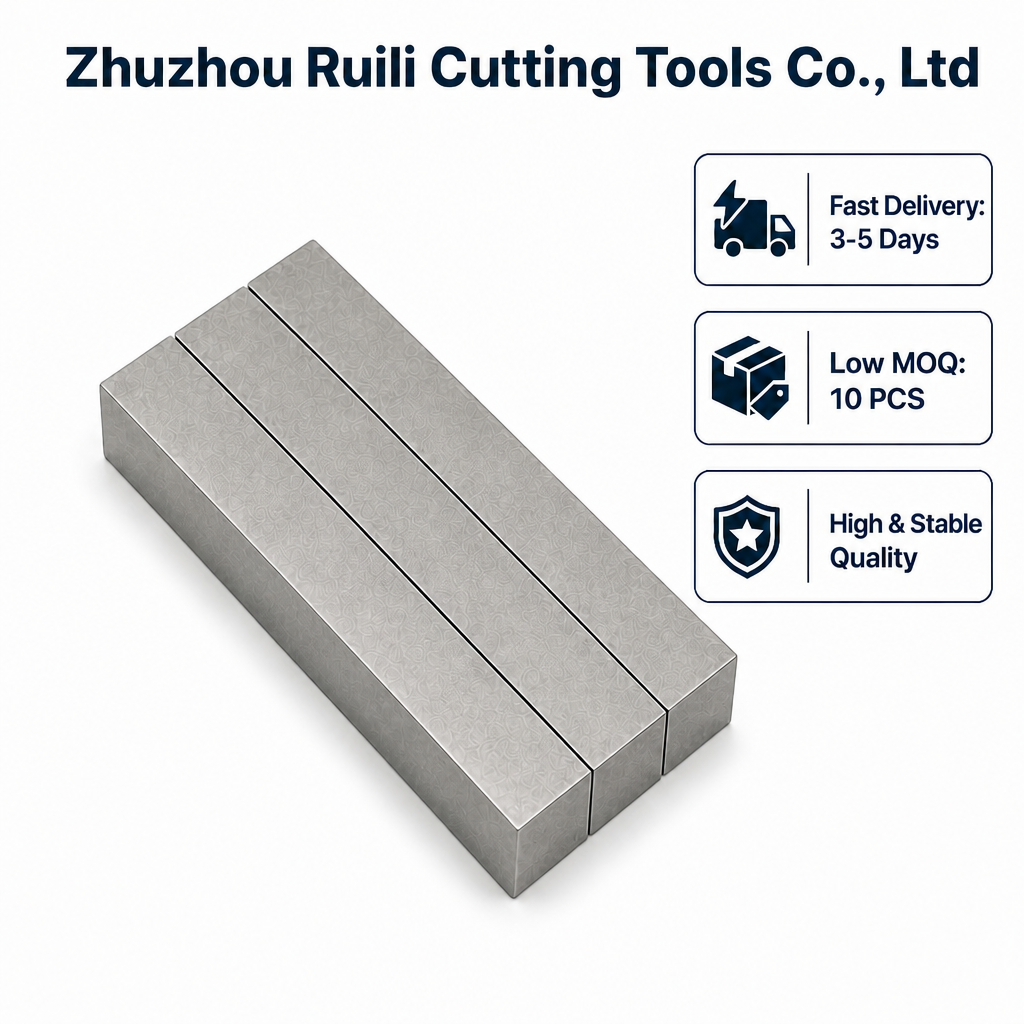
Tungsten carbide strips, also known as carbide flat bars or carbide rectangular strips, are basic semi-finished carbide products with regular flat rectangular structures. Manufactured through powder pressing, high-temperature sintering and precision flattening grinding, these strips feature uniform density, stable hardness and excellent wear resistance, serving as the most widely used base material for custom tooling production.
Unlike finished carbide blades or special-shaped dies, carbide strips are universal raw materials. Factories can perform secondary cutting, edge machining, hole drilling and shaping processing according to actual needs. They are widely used in mechanical cutting, industrial scraping, wear-resistant parts, woodworking tooling and custom mold processing fields.
The final service life and working performance of carbide strips largely depend on edge machining quality and grade matching. Many users only focus on strip size while ignoring edge treatment, resulting in edge chipping, rapid wear and poor cutting stability. This article systematically introduces mainstream applications and standard edge machining options for tungsten carbide strips, providing reliable selection guidance for tool manufacturers.
2. Core Performance Advantages of Carbide Strips
Tungsten carbide strips occupy an irreplaceable position in industrial tooling manufacturing due to their superior comprehensive mechanical properties compared with high-speed steel and alloy steel materials.
- Ultra-high wear resistance: Hard carbide substrate effectively resists abrasive wear from metal, wood, plastic and mineral materials, greatly extending tool service life.
- Excellent hardness retention: Maintain stable hardness under high friction and high-temperature working conditions, avoiding rapid tool passivation.
- Strong compression resistance: Uniform internal structure withstands continuous extrusion and load pressure, not easy to deform during long-term operation.
- High machining flexibility: Standard strip blanks support diversified secondary processing, adapting to countless non-standard tool shapes and sizes.
- Cost-effective batch application: Universal blank specifications reduce raw material procurement costs compared with fully customized special-shaped tools.
3. Common Industrial Applications of Carbide Strips
Tungsten carbide strips are versatile base materials covering multiple industrial processing scenarios. The mainstream applications are summarized as follows:
Cutting & Trimming Tools
Carbide strips are processed into straight cutting blades, slitting blades, trimming knives and shear blades for metal sheet cutting, film slitting, paper trimming and fabric cutting. The high hardness ensures sharp edge retention and long-term stable cutting effect.
Woodworking & Furniture Processing
Used as wood planer blades, carving strips and trimming blades. The precise machined edge realizes smooth wood cutting, effectively avoiding tool wear caused by wood fiber and sand impurities.
Wear-Resistant Industrial Parts
Processed into wear-resistant strips, guide rails, anti-friction plates and positioning blocks for mechanical equipment, reducing component replacement frequency caused by long-term friction loss.
Scraping & Cleaning Tools
Made into industrial scraper blades, ink scrapers, residue cleaning strips and glue scraping tools, widely used in printing, packaging and machinery cleaning industries.
Custom Mold & Die Blanks
Used as flat die blanks for stamping molds, forming molds and auxiliary tooling, providing high-precision base materials for secondary shaping and finishing.
4. Full Guide to Carbide Strip Edge Machining Options
Edge machining is the core process that determines the cutting performance and chipping resistance of carbide strips. Different edge treatments correspond to completely different working conditions. The mainstream standard edge machining options in the industry are as follows:
1. Raw Square Edge (Unprocessed Edge)
The original sintered and ground flat edge without any chamfering or sharpening treatment. It features maximum edge toughness and is not easy to chip under impact load. Suitable for wear-resistant parts and non-cutting structural accessories that do not require sharp edges.
2. Single Bevel Edge (Single-Sided Sharpening)
Grind a single inclined cutting edge on one side of the strip while retaining flat support on the other side. This machining method balances sharpness and stability, suitable for one-way cutting and trimming tools, widely used in woodworking and packaging slitting.
3. Double Bevel Edge (Double-Sided Symmetrical Sharpening)
Symmetrical sharpening on both sides to form a centered sharp edge. It features uniform cutting force and symmetrical stress, ideal for precision cutting and double-sided shearing tools, ensuring smooth cutting without deviation.
4. Rounded Corner Edge (R Chamfer)
Polish sharp right-angle corners into smooth rounded transitions. Effectively prevent edge cracking and corner chipping, suitable for frequent contact, vibration and impact working scenarios.
5. Flat Chamfer Edge (C Chamfer)
Remove sharp right-angle edges through flat chamfering treatment to eliminate stress concentration. Improve impact resistance while retaining basic flatness, commonly used for industrial wear-resistant strips and mechanical accessories.
6. Ultra-Polished Sharp Edge
Fine mirror polishing after precision grinding to achieve ultra-smooth cutting edge. No burrs, ultra-high finish, suitable for precision finishing cutting and high-surface-quality processing requirements.
5. Edge Machining Selection by Application Scenario
Reasonable edge machining matching can maximize the service life and working efficiency of carbide strips.
For woodworking cutting & soft material trimming: Choose single bevel edge or double bevel ultra-polished edge. Ensure ultra-sharp cutting performance to avoid wood tearing and material burrs.
For metal sheet slitting & hard material cutting: Select double bevel edge with small flat chamfer. Balance sharpness and impact resistance to prevent edge chipping during hard material cutting.
For mechanical wear-resistant strips & guide parts: Adopt raw square edge or C-type flat chamfer edge. Prioritize structural stability and toughness without pursuing sharpness.
For vibration & intermittent working conditions: Use R rounded corner edge treatment to eliminate stress concentration and avoid fatigue cracking of sharp corners.
For high-precision finishing processing: Must adopt ultra-polished sharp edge to ensure workpiece surface finish and dimensional consistency.
6. Grade Selection Rules for Different Working Conditions
Cooperating with correct edge machining, targeted carbide grade selection further optimizes strip performance.
- Wear-resistant priority scenarios: Choose fine-grain low-cobalt grades. High surface hardness resists long-term friction and delays wear speed.
- Cutting & impact scenarios: Adopt medium-grain balanced grades. Balance wear resistance and toughness to avoid edge chipping during cutting impact.
- High-frequency vibration & intermittent cutting: Select high-toughness high-cobalt grades. Enhance anti-cracking performance and adapt to unstable load conditions.
- Precision finishing tools: Use ultra-fine grain grades. Ensure uniform material structure and stable edge retention for high-precision processing.
7. Machining Option & Application Comparison Table
This table intuitively sorts out applicable working conditions and performance characteristics of all edge machining types for carbide strips.
| Edge Machining Type | Core Feature | Advantage | Best Application Scenario |
|---|---|---|---|
| Raw Square Edge | Original flat right angle, no sharpening | Maximum toughness, anti-crack | Mechanical wear-resistant strips, structural parts |
| Single Bevel Edge | One-sided sharp cutting angle | Stable cutting, good support | Woodworking blades, one-way trimming tools |
| Double Bevel Edge | Symmetrical double-sided sharpening | Uniform force, precise cutting | Metal slitting, precision shearing blades |
| Rounded R Edge | Smooth arc corner transition | Anti-chipping, anti-fatigue | Vibration working conditions, frequent friction parts |
| Flat C Chamfer Edge | Flat right-angle removal | Stable structure, stress-free | Industrial wear plates, guide strips |
| Ultra-Polished Edge | Mirror smooth sharp edge | Burr-free, high finish | Precision finishing, high-standard trimming |
8. Common Usage Mistakes & Optimization Tips
Most premature failure of carbide strips comes from mismatched edge machining and improper usage habits.
Mistake 1: Using ultra-sharp polished edges for heavy-impact cutting. Excessively sharp edges lack toughness and are prone to large-area chipping under heavy load.
Mistake 2: Adopting raw square edges for precision cutting. Unpolished edges have poor flatness, resulting in workpiece burrs and uneven cutting surfaces.
Mistake 3: Universal edge treatment for all materials. Soft materials need ultra-sharp edges, while hard materials require chamfered reinforced edges.
Mistake 4: Ignoring edge stress elimination. Unprocessed sharp right angles are prone to stress concentration and crack expansion during long-term cyclic work.
9. FAQ About Carbide Strips Machining
Q1: Can carbide strips be re-machined after edge wear?
Yes. Worn carbide strips can be re-ground, sharpened and chamfered to restore cutting performance, realizing repeated reuse and reducing costs.
Q2: Which edge type has the longest service life?
Chamfered or rounded edges have better structural stability and longer service life under heavy-load working conditions, while polished sharp edges are suitable for light-load precision processing.
Q3: Do all carbide strips need edge treatment?
Non-cutting wear-resistant structural parts can retain raw edges, while cutting tools must complete professional edge machining to ensure effect and durability.
Q4: Can you customize special edge angles and special chamfer sizes?
Yes. We support personalized edge angle, chamfer size and polishing standard customization according to customer tool drawings and working conditions.
10. Summary & Custom Carbide Strip Service
Tungsten carbide strips are essential universal base materials for industrial tool manufacturing. Different edge machining options completely change their cutting performance, toughness and service life. Square edges focus on structural stability, bevel edges focus on cutting sharpness, and chamfered/rounded edges focus on impact resistance and fatigue resistance.
Enterprises should select matching edge machining schemes and carbide grades according to processing materials, load intensity and precision requirements, instead of adopting unified processing standards blindly. Scientific matching can significantly reduce tool loss rate and improve product processing quality.
We supply full-spec tungsten carbide strips with complete edge machining options, supporting custom size, grade, edge angle and surface polishing treatments for various industrial tooling needs.
Our Carbide Strip Products
Standard Tungsten Carbide Strips
High-density sintered carbide flat strips with stable hardness and wear resistance, available in various conventional sizes for tool blank processing and wear-resistant parts production.
Learn More → /custom-carbide-parts.htm
Custom Machined Carbide Strips
Support single bevel, double bevel, chamfer, rounded corner and ultra-polished edge machining, providing one-stop finished strip solutions for cutting tool manufacturers.
CTA Contact Zone
Custom Machining & Technical Matching
📧 Contact Us → /contact-us.htm
Provide your application scenario and processing requirements, get free edge machining and carbide grade matching suggestions.
Bulk Wholesale & Long-Term Cooperation
📧 Contact Us → /contact-us.htm
Factory direct sales of carbide strips with customizable edge treatments, stable quality and competitive prices.
Disclaimer
The machining and selection suggestions in this article are for general industrial reference. Actual strip service life and working effect are affected by processing materials, equipment parameters and working load. Please consult our technical team for personalized solutions for special working conditions.