Sharpening Machine Carbide Blades: Material, Edge Geometry & Wear Performance
- Share
- publisher
- Jane
- Issue Time
- Sep 18,2026
Summary
This professional guide analyzes sharpening machine carbide blades from substrate material, edge geometry design and wear performance. It explains how carbide grade, edge angle, clearance and structural design affect sharpening precision and service life, summarizes common failure modes, and provides practical selection and maintenance tips for sharpening machine accessories.
Full Article Structure
- 1. Introduction: Role of Carbide Blades in Sharpening Machines
- 2. Carbide Blade Substrate Material & Grade Selection Rules
- 3. Core Edge Geometry Parameters Explained
- 4. How Edge Geometry Affects Sharpening Precision & Stability
- 5. Wear Performance & Main Failure Modes of Carbide Blades
- 6. Material & Geometry Parameter Comparison Table
- 7. Practical Application Cases in Tool Sharpening
- 8. Common Selection & Usage Mistakes
- 9. Blade Selection & Maintenance Guide
- 10. Summary & Custom Carbide Blade Service
1. Introduction: Role of Carbide Blades in Sharpening Machines
Sharpening machine carbide blades are core wearable parts installed on tool grinders, cutter sharpeners and industrial sharpening equipment. They are responsible for trimming, shaping and finishing the cutting edges of end mills, drills, turning inserts and custom cutting tools. Compared with high-speed steel blades, solid carbide blades feature higher hardness, better thermal stability and far lower wear rate, making them the mainstream choice for industrial precision sharpening.
In actual workshop operation, many equipment users only replace worn blades with generic alternatives, ignoring substrate material differences and edge geometric parameters. Unmatched carbide grades or unreasonable edge angles will cause poor sharpening uniformity, tool edge burrs, low dimensional consistency and frequent blade replacement, greatly increasing equipment downtime and operating costs.
This article focuses on three core dimensions of sharpening machine carbide blades: substrate material grade, edge geometric design and actual wear performance. It explains parameter matching logic, analyzes typical failure causes, and provides systematic selection and maintenance guidance for sharpening equipment manufacturers and workshop operators.
2. Carbide Blade Substrate Material & Grade Selection Rules
The service life and working stability of sharpening machine blades are fundamentally determined by the WC-Co carbide substrate. Sharpening scenarios involve continuous abrasive friction, local high temperature and occasional impact load, requiring balanced hardness and toughness from the blade material.
- Fine-grain low-cobalt grade: Delivers ultra-high hardness and excellent abrasive wear resistance. Suitable for long-term continuous sharpening of hard alloy tools and hardened steel cutters. It maintains stable edge profile and avoids rapid material loss.
- Medium-grain balanced grade: Features moderate cobalt content, balancing wear resistance and impact toughness. Tolerates minor vibration and intermittent sharpening load, ideal for general-purpose multi-tool sharpening scenarios.
- High-cobalt coarse-grain grade: Focuses on impact resistance and fracture resistance. Applied to heavy-load rough sharpening and uneven tool blank trimming, effectively preventing blade cracking and edge chipping.
For precision sharpening machines pursuing high repeat accuracy, fine-grain carbide is the preferred substrate. For universal grinding equipment with mixed working conditions, medium balanced grades offer the best comprehensive performance and cost performance.
3. Core Edge Geometry Parameters Explained
Edge geometry is the key factor that directly controls sharpening quality. Even with the same carbide material, different geometric designs will produce completely different sharpening effects. The three core parameters include rake angle, clearance angle and edge radius.
Rake Angle: Determines cutting sharpness during tool trimming. A larger rake angle provides sharper cutting performance, reducing grinding resistance and avoiding tool edge extrusion deformation. A smaller rake angle enhances blade body stability and is not prone to edge collapse under heavy load.
Clearance Angle: Ensures effective gap between the blade flank and the workpiece tool surface. Reasonable clearance avoids friction interference, prevents secondary scratching of the sharpened tool edge, and guarantees smooth chip removal during sharpening.
Edge Radius: Refers to the rounded transition of the blade tip. Micro-edge radius improves wear resistance and edge durability, while ultra-sharp zero-radius edges are suitable for ultra-precision finishing sharpening but have weaker anti-impact performance.
4. How Edge Geometry Affects Sharpening Precision & Stability
Unreasonable edge geometry is the main hidden cause of poor sharpening quality. Many precision tool defects are not caused by equipment accuracy, but by mismatched blade parameters.
Excessively sharp edges with no rounded radius will wear quickly during continuous sharpening. The blade tip gradually collapses and forms an irregular curved surface, resulting in inconsistent tool edge angles and poor batch consistency of finished tools. Too large clearance angle will weaken the blade edge support, leading to micro-vibration during operation and producing tiny tool edge burrs.
Conversely, standardized edge geometry with scientific angle matching can maintain long-term profile stability. It ensures uniform material removal every time, effectively improving the dimensional accuracy, surface finish and batch repeatability of sharpened tools.
5. Wear Performance & Main Failure Modes of Carbide Blades
Sharpening machine carbide blades work under continuous high-speed friction and alternating temperature, with three typical failure modes affecting service life and working performance.
Abrasive flank wear: The most common failure. Long-term friction with hard tool blanks causes gradual uniform wear on the blade edge, changing the original geometric angle and reducing sharpening accuracy.
Edge chipping and micro-cracking: Caused by sudden impact, uneven tool placement or unstable equipment operation. Local edge collapse directly leads to scrapping of the blade and affects the flatness of the sharpened tool edge.
Thermal fatigue wear: Continuous sharpening generates instantaneous high temperature, causing repeated thermal expansion and contraction of the blade surface. Long-term accumulation produces tiny fatigue cracks, resulting in peeling and uneven wear.
High-quality carbide blades with stable grain structure and reasonable cobalt ratio can effectively delay the above failure phenomena and extend continuous service cycle.
6. Material & Geometry Parameter Comparison Table
This table summarizes applicable materials, geometric parameters and wear characteristics for mainstream sharpening machine carbide blades.
| Blade Grade Type | Recommended Edge Feature | Wear Performance | Best Application Scenario |
|---|---|---|---|
| Fine-grain Low-cobalt | Small clearance + micro edge radius | Ultra-low abrasive wear, long service life | Precision tool finishing sharpening, continuous mass production |
| Medium-grain Balanced | Standard rake & clearance angle | Balanced wear & chipping resistance | General-purpose tool sharpening, mixed working conditions |
| High-cobalt Coarse-grain | Enhanced edge support angle | Excellent anti-impact performance | Rough trimming, heavy-load sharpening, irregular blank processing |
7. Practical Application Cases in Tool Sharpening
Case 1: Precision end mill sharpening workshop
A tool sharpening factory originally used ordinary medium-grain carbide blades for high-precision end mill finishing. After long-term operation, blade edge wear was uneven, resulting in unstable tool edge flatness and frequent rework. After switching to fine-grain low-cobalt blades with micro-edge radius design, the blade profile remained stable for a long time. The tool sharpening qualification rate increased significantly, and blade replacement cycle extended by more than 50%.
Case 2: Universal multi-function sharpening equipment
A comprehensive machining workshop needs to sharpen drills, inserts and custom tools alternately with unstable load conditions. Early use of high-hardness fine-grain blades caused occasional edge chipping. After replacing with balanced medium-grain carbide blades with standard geometric angles, the blades adapted to intermittent impact load, zero chipping failure occurred, and overall equipment operation stability was greatly improved.
8. Common Selection & Usage Mistakes
Most blade premature failures and poor sharpening quality come from several typical misunderstandings in selection and daily use.
First mistake: Blindly pursuing ultra-high hardness. Pure high-hardness fine-grain blades lack toughness. They are easy to chip under unstable equipment vibration and mixed load conditions.
Second mistake: Ignoring edge geometric parameters. Users often only pay attention to blade size and material grade, while mismatched angles lead to poor sharpening finish and rapid profile failure.
Third mistake: Long-term overloaded continuous operation. Continuous high-temperature sharpening without cooling will cause thermal fatigue of carbide blades, resulting in accelerated surface peeling and wear.
Fourth mistake: One-type-blade-for-all-scenarios. Using the same blade for rough trimming and precision finishing cannot balance efficiency and accuracy, causing unnecessary cost waste.
9. Blade Selection & Maintenance Guide
To maximize carbide blade performance and service life, follow targeted selection and maintenance rules based on working scenarios.
- Precision finishing sharpening: Choose fine-grain low-cobalt blades with standardized micro-edge radius to ensure long-term stable precision.
- General mixed sharpening: Adopt medium balanced grade blades with standard edge angles to adapt to diversified tool processing.
- Heavy rough sharpening: Select high-toughness high-cobalt blades with enhanced edge support to avoid chipping and fracture.
- Daily maintenance: Keep blade surface clean, ensure effective cooling during operation, avoid dry grinding, and regularly check edge profile wear to timely adjust or replace blades.
10. Summary & Custom Carbide Blade Service
The comprehensive performance of sharpening machine carbide blades is determined by the combination of substrate material grade and edge geometric design. Fine-grain materials excel in wear resistance for precision sharpening, while high-cobalt materials provide impact resistance for heavy-load trimming. Reasonable rake angle, clearance angle and edge radius can stabilize sharpening accuracy and extend blade service life.
Enterprises should select matching blades according to actual sharpening load, tool type and precision requirements, instead of blindly pursuing high hardness or low price. Standardized use and daily maintenance can effectively reduce equipment operating costs and improve tool batch qualification rate.
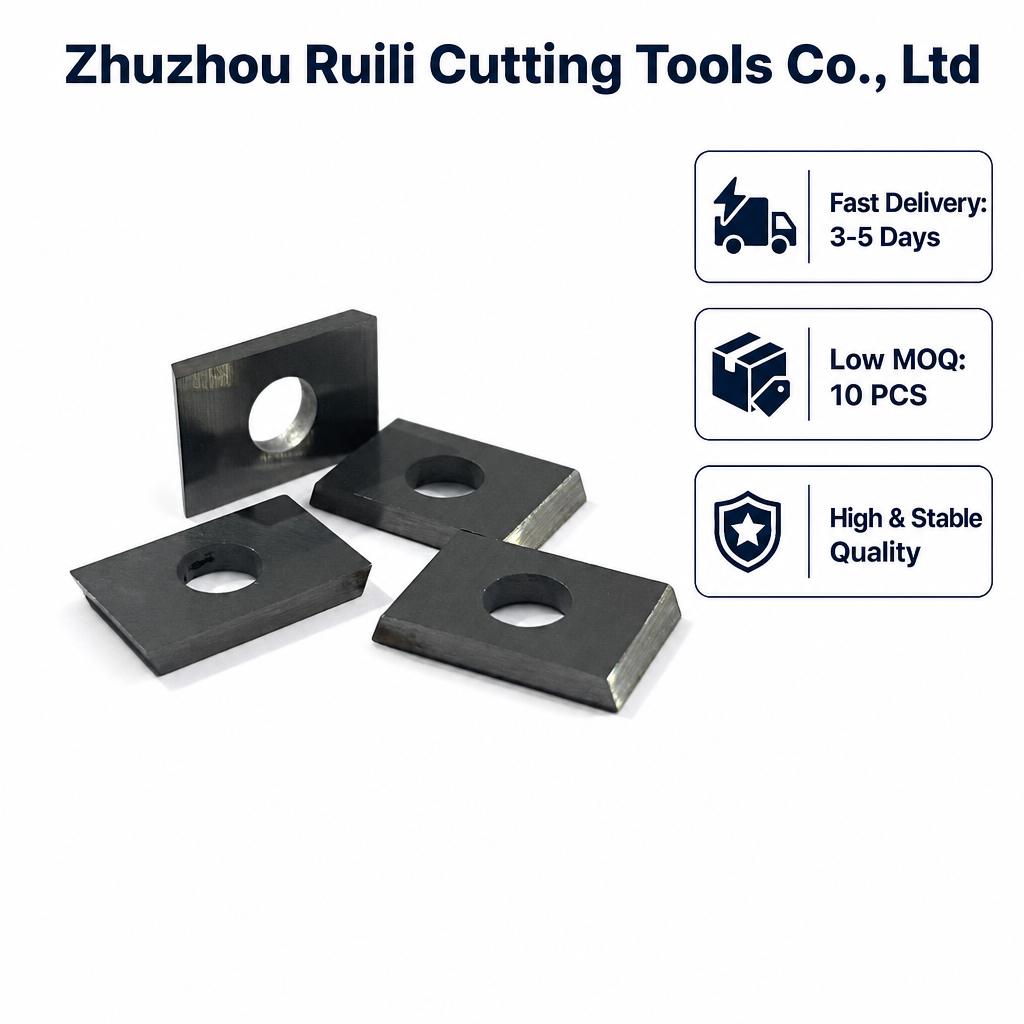
We provide full-series standard sharpening machine carbide blades with multiple grades and complete edge specifications. Custom blade geometry, special grades and non-standard sizes are supported for personalized equipment and process requirements.
Our Carbide Blade Products
Standard Sharpening Machine Carbide Blades
Ready-stock carbide blades for industrial sharpening machines, including fine-grain, medium balanced and high-toughness grades. Stable wear resistance and precise edge geometry for tool grinding and sharpening equipment.
Learn More → /custom-carbide-insert
Custom Geometry & Grade Blades
OEM & ODM custom carbide blades with personalized edge angles, edge radius and special substrate grades, matching special sharpening equipment and unique processing techniques.
CTA Contact Zone
Technical Consultation & Custom Solutions
📧 Contact Us → /contact-us.htm
Share your sharpening machine model, processing tool type and precision requirements. Get free blade grade and geometry selection suggestions.
Bulk Procurement & Long-Term Cooperation
📧 Contact Us → /contact-us.htm
Competitive wholesale price for bulk carbide blade orders, stable batch quality and long-term supply support for equipment manufacturers and processing factories.
Disclaimer
The performance and selection suggestions in this article are for general industrial reference. Actual blade service life and sharpening effect are affected by equipment stability, cooling conditions, operating parameters and processing objects. Please consult our technical team for professional matching recommendations before bulk procurement.