How to Select Tungsten Carbide Grades for Different Machining Operating Conditions
- Share
- publisher
- Bree
- Issue Time
- Nov 6,2026
Summary
Learn how to pick the correct tungsten carbide grade according to your actual machining operating conditions. We share a real case helping a turning workshop cut tool failure rate by 60% via grade matching.
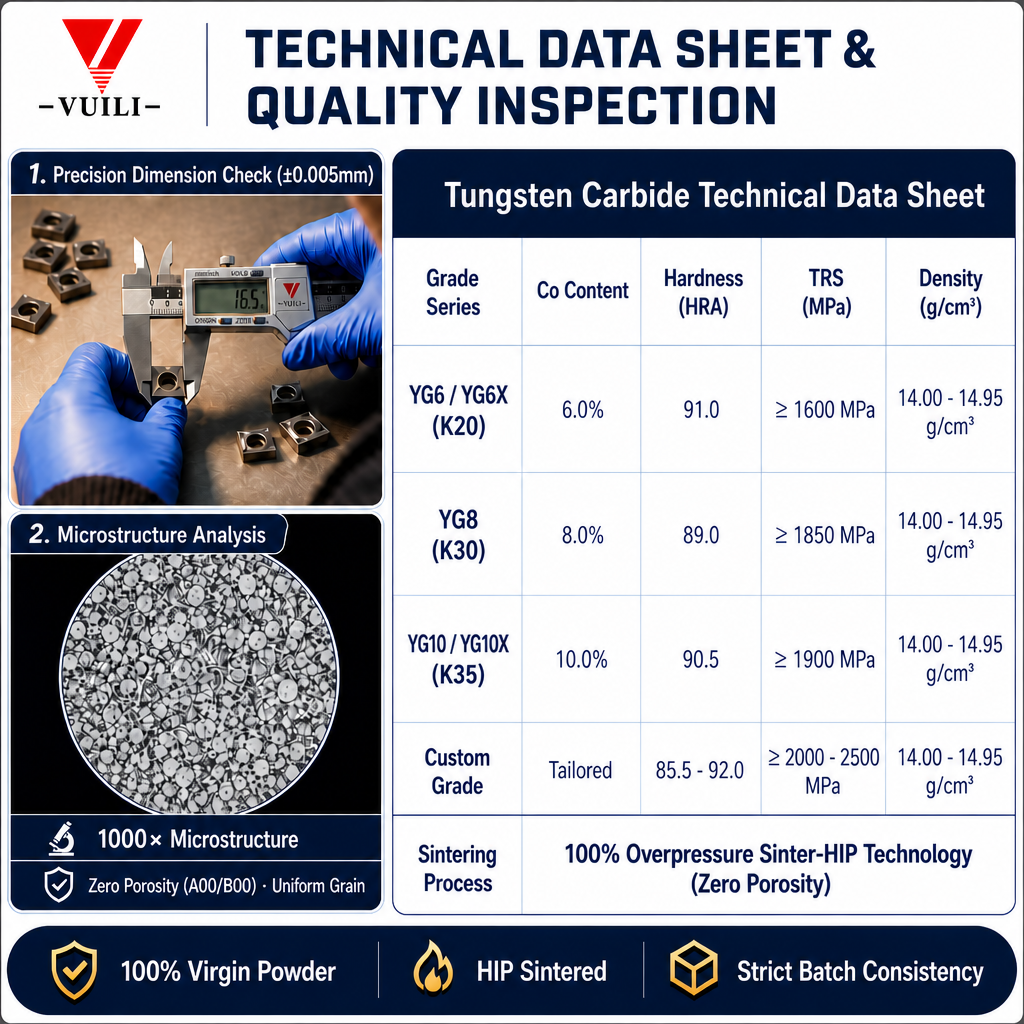
Full Article Structure
- 1. Introduction: Why Grade Matching Matters for Operating Conditions
- 2. Key Factors To Judge Your Machining Operating Conditions
- 3. Carbide Grade Matching Table For Typical Machining Scenarios
- 4. Real Customer Case: Wrong Grade Causes Short Tool Life
- 5. Common Grade Selection Mistakes Buyers Make
- 6. FAQs About Tungsten Carbide Grade Selection
- 7. Summary: Pick Grades Based On Actual Working Conditions
1. Introduction: Why Grade Matching Matters for Operating Conditions
Many buyers choose carbide grades only by price or habit, ignoring the actual operating conditions: workpiece material, cutting speed, impact load, cooling situation. A grade that works well for finishing steel may chip quickly under interrupted cast iron cutting. Correct grade selection is the foundation of stable tool life.
2. Key Factors To Judge Your Machining Operating Conditions
- Workpiece material: carbon steel, stainless steel, cast iron, aluminum alloy, hard alloy
- Cutting type: continuous finishing / roughing / interrupted cutting with impact
- Cooling condition: flood coolant, MQL, dry cutting (high temperature)
- Load feature: steady low load or heavy shock impact load
- Surface requirement: high surface finish or rough removal only
3. Carbide Grade Matching Table For Typical Machining Scenarios
| Operating Condition | Recommended WC Grade | Core Advantage |
|---|---|---|
| Continuous finishing of steel, stable cutting | Fine grain, low cobalt content | High hardness, good wear resistance |
| Interrupted rough turning / milling with impact | Medium grain, higher cobalt content | Better toughness, anti-chipping |
| Dry cutting, high temperature without coolant | Ultra-fine grain with special inhibitor | Anti-oxidation, resist thermal softening |
| Aluminum alloy non-ferrous machining | Low binder, polished grade | Anti-built-up edge |
4. Real Customer Case: Wrong Grade Causes Short Tool Life
A European tool maker bought fine grain low-cobalt carbide rods for cast iron milling with heavy interrupted cuts. Under this impact operating condition, inserts chipped within 10 pieces, tool life was extremely unstable.
We analyzed their working parameters: dry milling, frequent entry-exit impact on grey cast iron. We switched the blank grade to medium grain with 8% cobalt, adjusted sintering process to boost transverse rupture strength. After testing, chipping failure dropped 60%, average tool life doubled, and the customer stabilized their mass production.
5. Common Grade Selection Mistakes Buyers Make
- Always pick hardest grade for every job, ignoring impact risk
- Use high-tough grade for finishing, leading to fast flank wear
- Ignore dry cutting high temperature and use standard general grade
- Change workpiece material but keep the same carbide blank grade
6. FAQs About Tungsten Carbide Grade Selection
Q1: Can one carbide grade fit all machining conditions?
No. Hardness and toughness are a trade-off. No universal grade works for both heavy impact and ultra-precision finishing.
Q2: If I change cutting speed, do I need to change carbide grade?
Large speed changes bring big temperature shift. If you switch to high-speed dry cutting, grade upgrade is usually required.
Q3: Can you customize carbide grades for my unique operating condition?
Yes, we adjust WC grain size, cobalt content and additives to match your specific working environment.
7. Summary: Pick Grades Based On Actual Working Conditions
Grade selection is not just picking a YG/YT code. You need to describe your full operating conditions: material, cutting method, coolant, impact frequency. Send us your machining data, and we can recommend the most suitable carbide blank grade for your project.
CTA Contact Zone
Get Carbide Grade Recommendation
📧 Contact Us → /contact-us.htm
Share your machining operating conditions, we will suggest matched carbide grade and blank specification.
Request Grade Data Sheet
📧 Contact Us → /contact-us.htm
We provide full material property sheet of our carbide grades for your reference.
Disclaimer
Grade suggestions are for reference only. Final test and verification on your actual machine is required before mass production.