How to Match Carbide Grades to Machining Conditions for Optimal Tool Lifespan
- Share
- publisher
- Bree
- Issue Time
- Oct 7,2026
Summary
Wrong carbide grade selection shortens tool life and causes chipping or rapid wear. Learn how to match cemented carbide grades with different machining conditions including workpiece material, cutting speed, impact and abrasion. Select suitable Rleey tungsten carbide grades to maximize tool service life and stable machining performance.
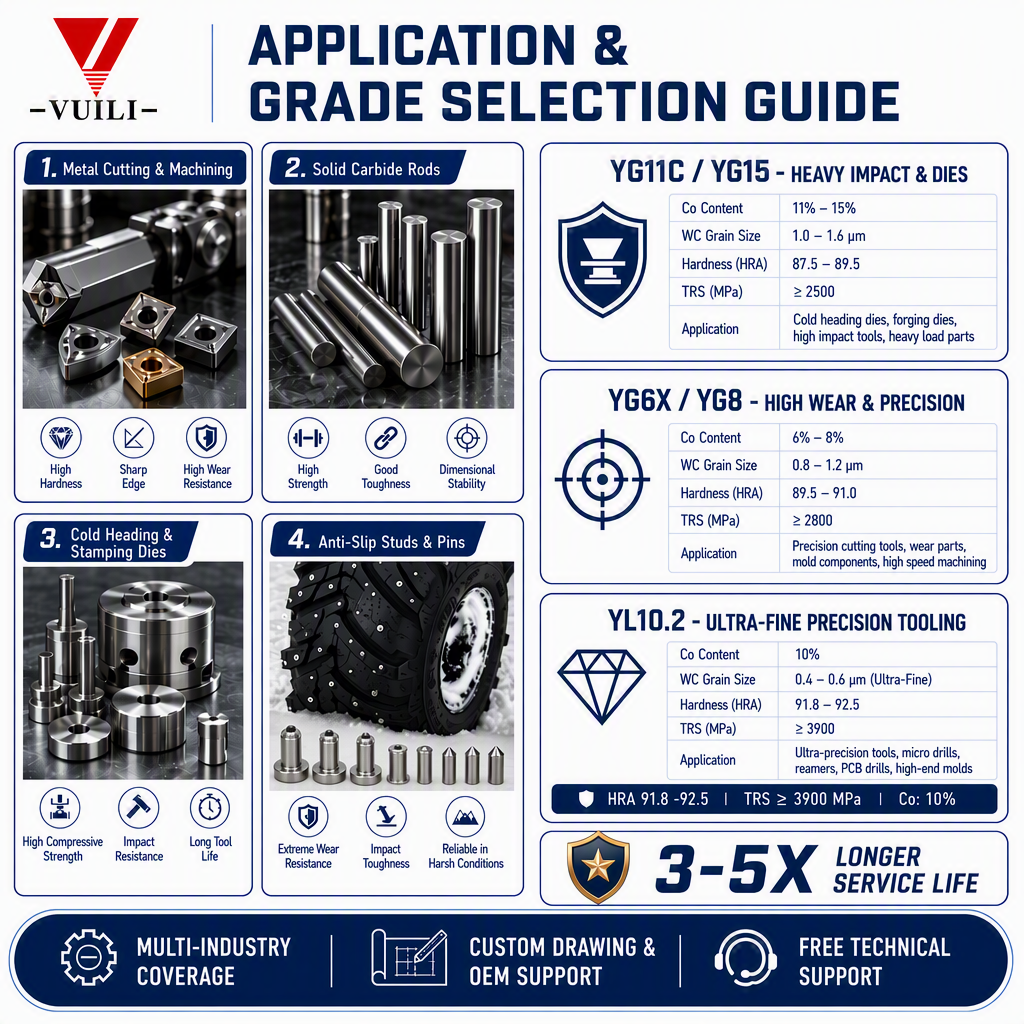
Full Article Structure
- 1. Introduction: Carbide Grade Selection Directly Decides Tool Lifespan
- 2. Core Machining Factors Affecting Carbide Grade Choice
- 3. Carbide Grade Matching by Workpiece Material
- 4. How Cutting Speed & Intermittent Cuts Change Grade Requirements
- 5. Carbide Grade Matching Reference Table
- 6. FAQ for Carbide Grade & Machining Condition Matching
- 7. Summary & VUILI Grade Recommendation Service
1. Introduction: Carbide Grade Selection Directly Decides Tool Lifespan
Many machinists pick carbide grades only by habit, without matching to real machining conditions. Using too brittle grade for interrupted cutting causes edge chipping; overly tough grades for high-speed continuous machining lead to fast flank wear. Proper carbide grade matching maximizes tool lifespan, stabilizes cutting quality and lowers per-part machining cost.
2. Core Machining Factors Affecting Carbide Grade Choice
- Workpiece material: steel, stainless steel, cast iron, non-ferrous metal, hard abrasive material
- Machining mode: continuous turning / milling or intermittent cutting with impact
- Cutting speed and feed rate: high speed vs low speed heavy cutting
- Coolant usage: dry cutting or wet cooling
- Required surface finish and dimensional stability
3. Carbide Grade Matching by Workpiece Material
For cast iron and abrasive non-ferrous materials, low cobalt carbide grades with high hardness deliver good wear resistance. Stainless steel and high tensile steel generate high cutting heat, requiring balanced grades to resist thermal wear. Interrupted cutting of hard steel needs higher cobalt carbide grades to absorb impact and avoid chipping.
4. How Cutting Speed & Intermittent Cuts Change Grade Requirements
High-speed continuous machining prioritizes wear resistance. Select fine grain, low cobalt carbide. Heavy load, intermittent milling or forging residual skin machining brings shock loads; choose higher cobalt, tougher carbide grades. Dry cutting creates thermal shock, which also demands higher toughness grades to prevent thermal cracking.
5. Carbide Grade Matching Reference Table
| Machining Condition | Grade Feature Recommendation | Typical Application |
|---|---|---|
| Continuous high-speed cutting, abrasive workpiece | Low cobalt, fine grain, high hardness | Cast iron, aluminum alloy continuous turning |
| Mixed continuous & light impact cutting | Medium cobalt, balanced hardness & toughness | Stainless steel, general steel turning & milling |
| Heavy interrupted cutting, strong impact | Higher cobalt, coarse grain, high toughness | Hardened steel, rough milling with scale |
6. FAQ for Carbide Grade & Machining Condition Matching
Q1: Can one carbide grade handle all machining materials?
No. Each grade is optimized for specific wear, heat and impact environment. Universal grades compromise either wear resistance or toughness.
Q2: Can VUILI customize carbide grain size and cobalt ratio for special machining?
Yes, we adjust material formula to match unique cutting scenarios and workpiece materials.
Q3: Is coating more important than carbide substrate grade?
Coating improves performance, but substrate carbide grade decides basic toughness and wear resistance. Poor substrate cannot be fixed only by coating.
7. Summary & VUILI Grade Recommendation Service
Match carbide grade to workpiece material, cutting speed and impact level to extend tool life. Analyze whether your main failure mode is wear, chipping or thermal crack before selecting grades. Send your machining parameters to VUILI’s engineering team to get tailored carbide grade suggestions for your cutting tasks.
CTA Contact Zone
Carbide Grade Matching Consultation
📧 Contact Us → /contact-us.htm
Send workpiece info and cutting parameters, get professional carbide grade recommendation.
Custom Carbide Tool Substrate Inquiry
📧 Contact Us → /contact-us.htm
Request quotation for cemented carbide blanks and inserts matched for your machining conditions.
Disclaimer
Grade recommendation is for reference only. Actual cutting performance depends on machine rigidity, cutting parameters, coolant and workpiece quality. Sample testing before mass production is recommended.