Ground Carbide Rod vs Sintered Blank Rod: Cost & Performance Comparison
- Share
- publisher
- Jane
- Issue Time
- Sep 18,2026
Summary
This blog compares ground carbide rods and sintered blank rods from dimensional accuracy, surface status, grinding workload, mechanical performance and procurement cost. It explains suitable application scenarios for each type, analyzes common selection pitfalls, and provides practical guidance for buyers to choose between sintered blanks and ground carbide rods according to grinding capacity and project budget.
Full Article Structure
- 1. Introduction: Two Main Forms of Tungsten Carbide Rod Blanks
- 2. Basic Definition of Sintered Blank Rod and Ground Carbide Rod
- 3. Comprehensive Cost & Performance Comparison Table
- 4. Advantages and Limitations of Sintered Blank Rods
- 5. Advantages and Limitations of Ground Carbide Rods
- 6. Real‑World Procurement Application Cases
- 7. Key Factors to Consider Before Making Your Selection
- 8. Typical Mistakes When Choosing Between Sintered and Ground Rods
- 9. Quick Application‑Based Selection Reference Table
- 10. Final Summary & Custom Processing Support
1. Introduction: Two Main Forms of Tungsten Carbide Rod Blanks
When purchasing solid carbide rod blanks for tool‑making or wear‑resistant parts, buyers will encounter two major product types: sintered blank rods and ground carbide rods. Both are produced from identical WC‑Co formula after high‑temperature sintering. The core difference lies in whether outer‑diameter precision grinding is performed after sintering.
Many purchasers simply judge by unit price: sintered blanks have lower per‑piece cost, so some customers tend to choose sintered blanks to save procurement budget. However, they often ignore downstream grinding time, machine wear, labor cost and scrap risk brought by large grinding allowance. The lowest raw‑material price does not always equal the lowest total comprehensive cost for your whole production workflow.
This article compares sintered blank rods and ground carbide rods from dimension accuracy, surface condition, grinding workload, unit price and total comprehensive cost. It lists suitable application boundaries, shares real‑production workshop cases and sorts out common procurement mistakes. It helps tool‑manufacturing enterprises and mechanical‑part factories make rational choices according to internal grinding equipment capacity and actual project requirements.
2. Basic Definition of Sintered Blank Rod and Ground Carbide Rod
A sintered blank rod is the carbide rod directly obtained after vacuum sintering, without any subsequent outer‑diameter grinding process. After sintering, the blank already completes metallurgical densification and possesses full mechanical hardness and toughness. But its outer surface retains sinter oxide skin, and dimensional tolerance and straightness are relatively poor due to sintering shrinkage deformation. Extra large material allowance is reserved for customer’s follow‑up full grinding removal.
A ground carbide rod is further processed with precision diamond wheel outer‑diameter grinding after sintering. The sinter skin is completely removed. Manufacturers control diameter tolerance, roundness and straightness to meet finished‑blank requirements. Ground rods are divided into standard‑ground grade and high‑precision‑ground grade according to different precision targets. Buyers can directly use them for small‑allowance grinding for end mills, drills and reamers.
It is critical to note: sintering determines the material’s intrinsic mechanical performance. Grinding is only a surface precision‑machining step and will not change the base hardness, density or TRS value of the carbide material. If the sintered blank itself has internal defects, grinding cannot eliminate those hidden material risks.
3. Comprehensive Cost & Performance Comparison Table
This table makes side‑by‑side comparison of core indicators between sintered blank rod and ground carbide rod.
| Comparison Item | Sintered Blank Rod | Ground Carbide Rod | Practical Influence for Buyers |
|---|---|---|---|
| Outer‑diameter Tolerance | +0.3 ~ +0.7 mm | ‑0.003 ~ ‑0.030 mm | Ground rod reaches precision ready‑for‑clamping level |
| Straightness & Roundness | Large deviation, uncorrected sintering deformation | Controlled, corrected by grinding & straightening | Sintered blanks require huge stock removal to fix geometry error |
| Surface Condition | With sinter oxide skin, porous sintered surface | Sinter skin removed, smooth ground surface | Sinter skin must be fully ground‑off before tool‑making |
| Supplier Processing Work | Only sintering, no OD grinding | Sintering + straightening + precision OD grinding | Ground rods contain factory‑side grinding processing cost |
| Unit Blank Procurement Cost | Low | Medium‑High, rises with precision grade | Sintered has lower purchase price per piece |
| Customer Internal Grinding Workload | Heavy: large grinding allowance, high wheel consumption & long machine time | Light: small grinding stock, short processing cycle | Comprehensive cost depends on your in‑house grinding capacity |
| Typical Suitable Usage | Large‑stock secondary grinding, non‑precision wear‑parts | End‑mill, drill, reamer blanks for tool‑making | Rotary precision cutting tools mostly adopt ground rods |
4. Advantages and Limitations of Sintered Blank Rods
Main advantages of sintered blank rods
- Lower unit purchase price, saving raw‑material procurement expenditure in the bill of material.
- Flexible finished‑size output: customers can grind down to many different target diameters from one sintered blank specification.
- Suitable for workshops with abundant grinding equipment and sufficient available machine‑hour resources.
Main limitations of sintered blank rods
- Huge grinding allowance consumes more diamond grinding wheels, increases machine‑tool wear and power consumption.
- Long processing cycle; heavy grinding workload reduces daily output of tool‑blank production.
- Sinter‑induced bending and warping exist. If your grinding process cannot remove enough stock, residual geometric error will remain on finished work‑pieces.
- Sinter oxide skin must be completely eliminated. Partial remaining sinter skin will bring surface micro‑defects to final carbide tools.
- High risk of scrap: improper heavy‑feed grinding may induce grinding‑cracks on carbide surface during large‑stock removal.
Therefore, sintered blank rods are not a universal low‑cost solution. They make economic sense only when your factory has plenty of idle grinding capacity and you really need multiple final diameters from one incoming blank dimension.
5. Advantages and Limitations of Ground Carbide Rods
Main advantages of ground carbide rods
- Precision dimension, straightness and roundness are already finished at supplier side. Customers only leave tiny finishing grinding allowance.
- Sinter oxide skin is fully removed, avoiding hidden surface defects caused by incomplete skin removal.
- Greatly reduces internal grinding time, diamond‑wheel loss and machine‑tool wear, improving production throughput.
- Stable incoming‑blank geometry reduces scrap rate in subsequent tool‑grinding procedure, especially critical for small‑diameter micro‑tool blanks.
Main limitations of ground carbide rods
- Higher unit purchase price because supplier has completed straightening and precision‑grinding procedures.
- Each ground‑rod specification corresponds to one target finished diameter. If you need many different final sizes, you need to stock multiple different ground‑rod dimensions.
- High‑precision ground grade further increases unit cost, so select high‑precision only for high‑end micro‑tool scenarios.
For most standard end‑mill, drill and reamer mass‑production workshops, ground carbide rods can lower total comprehensive manufacturing cost even though raw‑material unit price is higher.
6. Real‑World Procurement Application Cases
Case 1: Medium‑scale tool‑making workshop with limited grinding capacity
A small‑and‑medium‑size tool factory originally purchased sintered blank rods to save raw‑material purchase cost. Their existing grinding workshop was already running at full capacity. After receiving sintered blanks, heavy grinding workload caused machine‑tool bottleneck. Production lead‑time extended obviously, diamond‑wheel consumption increased sharply, and several batches generated scrap caused by insufficient stock removal for bent blanks. Later the factory switched to standard ground carbide rods. Even though raw‑material expense rose, machine‑hour pressure dropped greatly, overall output increased and total comprehensive production cost decreased by 31 %.
Case 2: Large‑scale plant with abundant grinding equipment resources
A large carbide‑tool manufacturer owns many CNC grinding machines with sufficient spare capacity. They need to process one incoming blank into multiple different finished diameters. Under this condition, they select sintered blank rods. By undertaking all OD‑grinding work internally, they avoid paying supplier external grinding fees. In this special situation, sintered blanks achieve real overall cost‑reduction for their mass‑production model.
7. Key Factors to Consider Before Making Your Selection
Before you decide to choose sintered blank rods or ground carbide rods, evaluate these key points for your own workshop:
- In‑house grinding capacity: Check available grinding‑machine quantity, machine‑hour saturation, diamond‑wheel consumption budget. If grinding resources are tight, ground rods are more reasonable.
- Target finished‑diameter variety: If you need many different final diameters converted from one incoming blank, sintered blanks bring inventory advantage. If each project corresponds to fixed single diameter, ground rods perform better.
- Tool‑blank type: Micro‑drill and small‑precision tool blanks are strongly recommended to adopt ground rods, because residual bending error of sintered blanks easily leads to high scrap rate. For large static wear‑resistant parts, sintered blanks are acceptable.
- Total‑cost accounting: Do not only compare blank unit price. Calculate full cost including raw‑material, grinding‑wheel wear, machine time, labor and scrap loss to get real comprehensive cost.
8. Typical Mistakes When Choosing Between Sintered and Ground Rods
Many procurement teams make wrong choices due to several typical misunderstandings.
First mistake: Equate lower blank unit price with lower total production cost. Sintered blanks transfer the grinding workload from supplier side to your internal workshop. If your grinding capacity is insufficient, extra machine‑hour and scrap loss will offset raw‑material savings.
Second mistake: Think sintered blanks can be directly used for rotary cutting‑tool blanks without sufficient grinding stock removal. Sinter oxide skin and bending deformation must be fully removed; partial retention will cause early‑failure of finished cutting tools.
Third mistake: Believe grinding can fix all material‑level defects. Grinding only changes geometry; internal pores, inclusions from sintering cannot be eliminated by outer‑diameter grinding, regardless of sintered or ground rods.
Fourth mistake: Ignore scrap risk of micro‑tool production using sintered blanks. Tiny‑diameter blanks have very little allowable stock‑removal margin, and residual bending will cause high scrap ratio.
9. Quick Application‑Based Selection Reference Table
Use this table for fast preliminary selection according to your application and workshop conditions.
| Application / Workshop Condition | Recommended Product Type | Important Reminder |
|---|---|---|
| End‑mill, drill, reamer mass‑production, normal grinding‑workshop capacity | Ground Carbide Rod | Reduces grinding burden and scrap risk for precision cutting‑tool blanks |
| Micro‑drill and small‑precision tool blanks | Ground Carbide Rod (Standard‑ / High‑precision) | Not suggested to use sintered blanks; residual bending causes high scrap rate |
| Ample idle grinding machines; multiple finished diameters from one incoming blank | Sintered Blank Rod | Must guarantee enough grinding allowance to remove sinter skin and bending deformation |
| Static non‑rotating wear‑resistant parts, large‑stock secondary grinding | Sintered Blank Rod | Non‑precision application scenarios where geometry error tolerance is higher |
10. Final Summary & Custom Processing Support
Sintered blank rod and ground carbide rod share identical sintered material substrate. The essential difference lies in whether supplier completes outer‑diameter grinding, straightening and sinter‑skin removal. Sintered blanks have low purchase price but bring heavy internal grinding workload. Ground rods raise raw‑material unit cost yet greatly decrease your machine‑time, wheel consumption and scrap risk.
Do not judge your choice merely by blank unit price. You need to comprehensively evaluate internal grinding‑equipment capacity, finished‑diameter diversity, tool‑blank precision requirement and total manufacturing cost. Precision rotary cutting‑tools such as micro drills, end‑mills and reamers are mostly suitable for ground carbide rods. Sintered blanks fit scenarios with abundant grinding capacity or non‑precision static wear‑parts.
Our factory supplies both sintered blank rods and multi‑precision‑grade ground carbide rods. We can also provide semi‑ground intermediate‑state blanks according to special customer‑defined grinding‑allowance requirements.
Carbide Rod Blanks: Sintered & Ground Options
Standard & High‑Precision Ground Carbide Rods
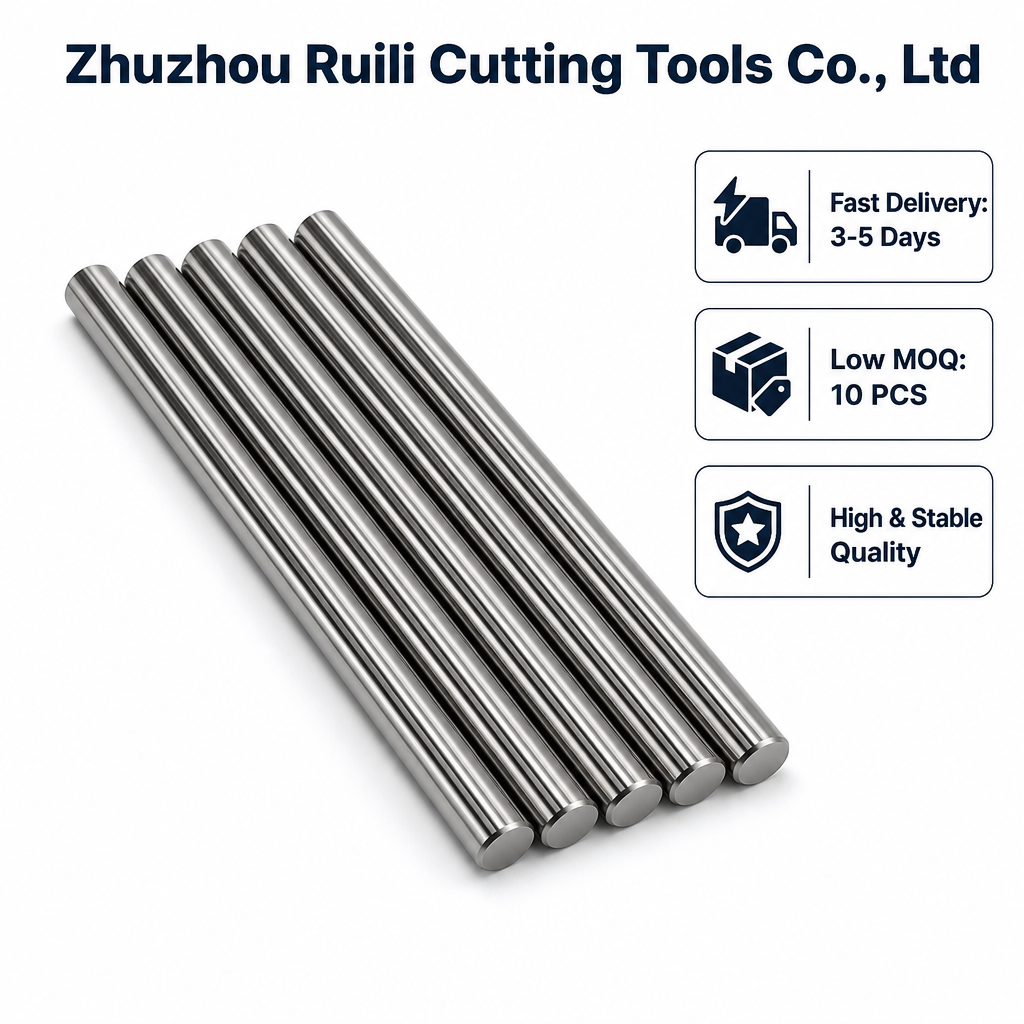
Full‑range ground carbide rods including standard‑ground and high‑precision‑ground grades. Sinter‑skin completely removed, controlled tolerance and straightness for end‑mill, drill and reamer blank manufacturing.
CTA Contact Zone
Technical Consultation & Custom Orders
📧 Contact Us → /contact‑us.htm
Tell us your finished‑tool type, available grinding‑capacity and target dimension requirements. Get free suggestion whether sintered blanks or ground rods better fit your project.
Bulk Procurement & Global Distributor Partnership
📧 Contact Us → /contact‑us.htm
Wholesale pricing for bulk sintered or ground carbide‑rod orders. Support long‑term supply contracts for tool‑making factories and industrial distributors.
Disclaimer
The information provided in this article is for general reference purposes only. Comprehensive production cost is affected by your internal equipment condition, labor cost, grinding‑wheel price and actual scrap ratio. Please consult our technical team for application‑specific recommendations before placing large‑volume procurement orders. All performance descriptions are based on standard industrial production conditions.