Carbide Wear Plates: Hardness, Thickness & Mounting Methods for Wear Protection
- Share
- publisher
- Jane
- Issue Time
- Sep 19,2026
Summary
This article focuses on tungsten carbide wear plates, explaining core parameters including hardness grade and thickness selection, as well as common mounting methods for industrial wear protection. It helps mechanical processing, mining and material handling factories select suitable carbide wear plates to reduce equipment abrasion and extend machine service life.
Full Article Structure
- 1. Introduction: Why Carbide Wear Plates Are Essential for Industrial Wear Protection
- 2. Core Performance: Hardness Grade Selection & Application Logic
- 3. Wear Plate Thickness Standard & Selection Rules
- 4. Four Main Carbide Wear Plate Mounting Methods
- 5. Matching Mounting Method with Working Conditions
- 6. Common Industrial Application Scenarios
- 7. Hardness & Thickness Selection Comparison Table
- 8. Common Installation Errors & Service Life Optimization Tips
- 9. FAQ for Carbide Wear Plates
- 10. Summary & Custom Wear Plate Solutions
1. Introduction: Why Carbide Wear Plates Are Essential for Industrial Wear Protection
Tungsten carbide wear plates are high-strength wear-resistant liner components widely used in mining, metallurgy, concrete mixing, material conveying and mechanical processing industries. Compared with steel plates, high-chromium alloy plates and manganese steel liners, carbide wear plates feature extreme hardness, low abrasion loss and stable structural durability, becoming the most reliable solution for severe industrial wear problems.
In material impact, friction conveying and high-scour working environments, traditional metal liners are prone to rapid thinning, surface peeling and frequent replacement, causing equipment downtime and increased maintenance costs. Carbide wear plates effectively solve these pain points by relying on ultra-high wear resistance and compression resistance.
The actual protection effect and service life of carbide wear plates depend on three core factors: reasonable hardness grade, matched plate thickness and standardized mounting method. This article systematically explains the selection standards of hardness and thickness, as well as the applicable scenarios of different installation methods, providing accurate technical reference for equipment manufacturers and industrial maintenance teams.
2. Core Performance: Hardness Grade Selection & Application Logic
Carbide wear plate hardness is mainly determined by tungsten carbide grain size and cobalt content. Different hardness grades correspond to completely different wear resistance, toughness and impact resistance, which must be matched according to actual working conditions.
High Hardness & Low Cobalt Grade
This grade features HRA 90–92 ultra-high hardness, fine and dense internal structure, and excellent anti-abrasion performance. It is suitable for fine particle friction, material sliding and continuous low-impact wear scenarios. It can maintain long-term stable surface finish and minimal thinning loss, greatly extending liner service life. However, due to relatively low toughness, it is not suitable for strong impact and heavy hammering environments.
Balanced Medium Hardness Grade
With moderate cobalt content and balanced hardness and toughness, this grade reaches HRA 88–90. It resists both abrasive wear and occasional material impact, adapting to most conventional industrial working conditions. It is the most versatile and cost-effective grade for general wear protection.
High Toughness & Medium Hardness Grade
Optimized with higher cobalt content and coarse grain structure, this grade has excellent impact resistance and anti-cracking performance. Although the hardness is slightly lower (HRA 85–88), it can withstand heavy material impact, large particle pounding and cyclic mechanical vibration, avoiding plate cracking and peeling failure in harsh working conditions.
3. Wear Plate Thickness Standard & Selection Rules
Plate thickness directly determines wear allowance, structural stability and overall service life. Unreasonable thickness selection will lead to either insufficient wear resistance or redundant cost waste.
Thin Plate (2mm–4mm)
Suitable for light-load friction equipment, small conveyor chutes, auxiliary guide surfaces and low-scour environments. Thin carbide plates are lightweight, easy to install and low-cost, meeting daily wear protection requirements for light-duty equipment.
Medium Plate (5mm–8mm)
The most common universal thickness, suitable for medium-frequency material conveying, powder sliding and conventional particle friction. It balances wear allowance and structural stability, applicable to most standard industrial wear protection scenarios.
Thick Plate (10mm–20mm+)
Designed for heavy-duty harsh environments, including mining chute lining, large stone impact, high-strength material scouring and long-term continuous operation. Thick plates provide sufficient wear allowance and strong compression resistance, avoiding rapid penetration and structural deformation under heavy load.
In principle, the higher the material hardness, the larger the particle size and the stronger the impact, the thicker the wear plate should be selected.
4. Four Main Carbide Wear Plate Mounting Methods
Different installation methods determine the firmness, stress resistance and replacement convenience of carbide wear plates. The industry has formed four mature and standardized mounting solutions.
1. Welding Mounting
Weld the carbide wear plate directly on the equipment steel base surface through surfacing and fixed-point welding. Features ultra-high firmness, no falling off under strong impact, suitable for heavy-load mining and large conveying equipment. It belongs to permanent fixed installation with high stability, but inconvenient for later replacement.
2. Bolt Fastening Mounting
Reserve bolt holes on carbide plates and fix them on equipment through bolts. The greatest advantage is convenient disassembly and replacement, suitable for equipment that requires regular maintenance and liner updating. It is widely used in medium and light-load wear protection scenarios.
3. Adhesive Bonding Mounting
Use high-strength industrial glue to bond wear plates on smooth equipment surfaces. Simple construction, no damage to equipment base, flat and smooth overall surface without welding gaps. Suitable for light friction, no strong impact and low vibration working environments.
4. Inlay & Combination Mounting
Embed carbide wear plates into the preset steel groove or fixed bracket, forming a composite wear-resistant structure. It combines the firmness of welding and the detachability of bolts, suitable for equipment local reinforcement and partial wear-prone areas.
5. Matching Mounting Method with Working Conditions
Scientific matching of installation method and working environment can avoid plate falling off, cracking and invalid wear protection.
Heavy impact & large particle scouring: Priority to welding mounting. Ensure overall structural firmness and resist instantaneous impact load.
Regular maintenance & frequent replacement equipment: Choose bolt fastening mounting. Realize quick disassembly and assembly to improve maintenance efficiency.
Smooth conveying & light friction equipment: Adopt adhesive bonding mounting. Keep the inner wall flat without material residue accumulation.
Partial wear reinforcement & local protection: Use inlay combination mounting for targeted strengthening of vulnerable areas.
6. Common Industrial Application Scenarios
Carbide wear plates are widely used in industries that face severe mechanical friction and material scouring.
- Mining industry: Chute lining, hopper wear plates, conveyor guide rails, crusher auxiliary liners
- Building materials industry: Concrete mixer liners, mortar conveying pipes, aggregate sliding plates
- Metallurgical industry: High-temperature conveying troughs, metal powder anti-wear liners
- Packaging & logistics: Material slideways, sorting machine anti-wear baffles
- Mechanical equipment: Custom anti-friction base plates, precision mechanical wear-resistant structural parts
7. Hardness & Thickness Selection Comparison Table
This table summarizes the optimal hardness grade and thickness configuration for different working scenarios.
| Working Condition | Recommended Hardness | Suitable Thickness | Core Advantage |
|---|---|---|---|
| Fine powder continuous friction | High hardness HRA90-92 | 2mm-5mm | Ultra-low abrasion loss, long service life |
| Conventional particle conveying | Balanced HRA88-90 | 5mm-8mm | Stable wear resistance & cost performance |
| Medium impact & mixed material scouring | Balanced HRA88-90 | 8mm-12mm | Anti-wear and anti-vibration |
| Heavy stone & large particle impact | High toughness HRA85-88 | 12mm-20mm | Anti-crack, anti-peeling, high stability |
| Light-load precision equipment | High hardness HRA90-92 | 2mm-4mm | Smooth surface, no material stuck |
8. Common Installation Errors & Service Life Optimization Tips
Many equipment wear failures are caused by improper installation and unreasonable parameter matching rather than plate quality problems.
Error 1: Pursuing ultra-high hardness for impact working conditions. Overly hard and brittle plates are prone to cracking under frequent impact, resulting in overall failure.
Error 2: Using thin plates for heavy scouring environments. Insufficient wear allowance leads to rapid thinning and penetration, requiring frequent replacement.
Error 3: Single installation method for all scenarios. Adhesive plates used in vibrating environments will easily fall off; bolted plates in high-friction scenes may cause material accumulation at holes.
Error 4: Uneven base installation surface. Unflat mounting surface causes local stress concentration, leading to partial wear and plate fracture.
Optimization Tip: Match hardness, thickness and mounting method according to actual materials and impact strength; ensure flat base contact and uniform stress distribution to maximize wear protection effect.
9. FAQ for Carbide Wear Plates
Q1: Are carbide wear plates better than manganese steel plates?
Yes. Tungsten carbide has far higher hardness and wear resistance than manganese steel, with 5–10 times longer service life in the same working environment.
Q2: Can carbide wear plates be customized in size and hole position?
Fully customizable. We support custom cutting, hole opening, chamfering and special-shaped processing to match various equipment installation sizes.
Q3: Which mounting method is the most durable?
Welding mounting has the highest firmness and durability, suitable for long-term heavy-duty operation; bolt mounting is more suitable for maintainable equipment.
Q4: Will high-hardness carbide plates crack easily?
High-hardness plates are wear-resistant but slightly brittle. They can work stably in friction scenarios but need high-toughness grades for strong impact conditions.
10. Summary & Custom Wear Plate Solutions
Carbide wear plates are core components for industrial equipment wear protection. Scientific selection of hardness grade, plate thickness and mounting method is the key to improving equipment durability and reducing maintenance costs. High-hardness thin plates adapt to light friction, while high-toughness thick plates target heavy impact and harsh scouring environments.
Welding, bolting, bonding and inlay mounting have their own applicable scenarios. Enterprises should avoid unified matching and select targeted installation schemes according to equipment operating conditions. Reasonable parameter configuration can maximize the service life of carbide wear plates and reduce comprehensive operating costs.
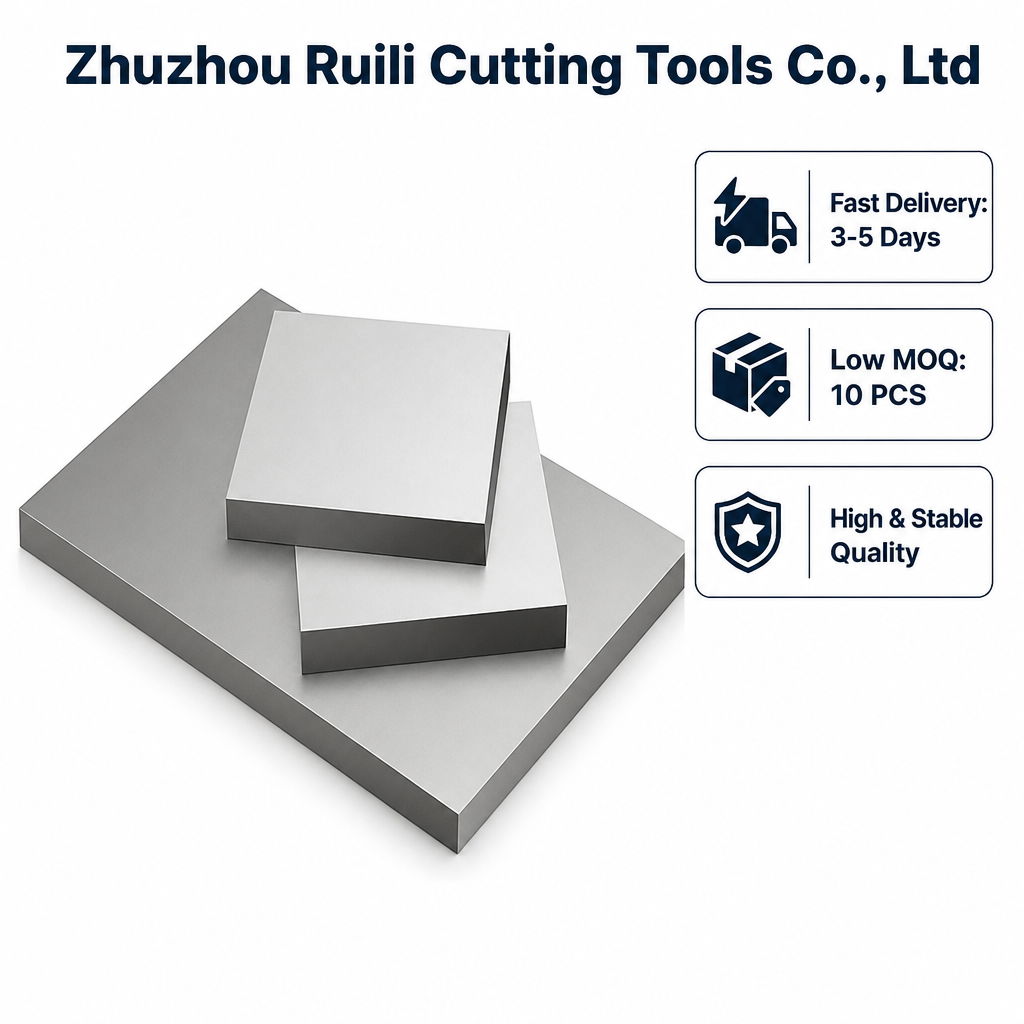
We supply full-series tungsten carbide wear plates with complete hardness grades and thickness specifications, supporting custom size, hole position and personalized installation processing.
Our Carbide Wear Plate Products
Standard Carbide Wear Plates
Multiple hardness grades and thickness options, high wear resistance and compression resistance, suitable for all kinds of industrial equipment anti-wear lining protection.
Learn More → /custom-carbide-parts.htm
Custom Processed Wear Plates
Support cutting, drilling, chamfering, welding groove processing and various mounting method customization, one-stop finished wear plate service.
CTA Contact Zone
Parameter Matching & Free Quotation
📧 Contact Us → /contact-us.htm
Tell us your working condition and installation requirements, get free hardness, thickness and mounting method matching suggestions.
Bulk Customization & Long-Term Cooperation
📧 Contact Us → /contact-us.htm
Factory direct sales of carbide wear plates, stable batch quality and competitive wholesale prices.
Disclaimer
The selection and mounting suggestions in this article are for general industrial reference. Actual wear protection effect and service life are affected by material properties, equipment vibration frequency and installation accuracy. Please consult our technical team for targeted solutions for special harsh working conditions.