Carbide Strips vs Carbide Plates: When to Use Strips and When to Use Solid Plates
- Share
- publisher
- Jane
- Issue Time
- Sep 19,2026
Summary
This industrial guide clarifies the differences between carbide strips and carbide solid plates, comparing their structural features, mechanical performance, cost and application scenarios. It helps manufacturers quickly determine whether to choose carbide strips or solid plates for tool making, wear protection and mechanical lining projects.
Full Article Structure
- 1. Introduction: Why Confuse Strips and Solid Plates
- 2. What Are Carbide Strips? Features & Core Advantages
- 3. What Are Carbide Solid Plates? Features & Core Advantages
- 4. Essential Differences Between Strips and Solid Plates
- 5. Best Use Cases for Tungsten Carbide Strips
- 6. Best Use Cases for Tungsten Carbide Solid Plates
- 7. Comprehensive Comparison Table
- 8. Common Selection Mistakes & How to Avoid Them
- 9. Quick Selection Guide for Engineers
- 10. Summary & Custom Carbide Blanks Service
1. Introduction: Why Confuse Strips and Solid Plates
Tungsten carbide strips and carbide solid plates are the two most common semi-finished blank materials in industrial tooling and wear protection manufacturing. Both are sintered carbide products with high hardness and excellent wear resistance, so many purchasing and engineering teams often confuse the two and use them interchangeably.
However, strips and solid plates differ greatly in structural thickness, stress resistance, machining range, load capacity and applicable working conditions. Improper selection will lead to tool edge chipping, plate bending deformation, insufficient wear allowance or unnecessary cost waste.
This article clearly distinguishes carbide strips and carbide solid plates, analyzes their respective strengths and weaknesses, and provides a precise selection standard, helping manufacturers choose the right carbide blank for cutting tools, wear liners, mold blanks and mechanical anti-wear parts.
2. What Are Carbide Strips? Features & Core Advantages
Carbide strips are long, thin rectangular carbide blanks with narrow width and limited thickness. They are mainly designed for edge machining, linear cutting tools and strip-shaped wear parts. Standard carbide strips feature uniform linear structure, neat edges and consistent hardness throughout the body.
Key Advantages of Carbide Strips
- Excellent edge machining performance: Easy to bevel, polish and sharpen, ideal for making sharp cutting edges.
- Light weight & low material cost: Thin and slender structure avoids material waste for linear tool production.
- High machining flexibility: Easy to cut into small segments, drill and process into various strip-shaped tools.
- Uniform linear wear resistance: Perfect for long-stroke friction and linear trimming scenarios.
Limitations of Carbide Strips
Due to thin thickness and narrow cross-section, carbide strips cannot bear heavy vertical impact and large-area compression load. They are easy to bend or break when used as thick wear-resistant structural plates.
3. What Are Carbide Solid Plates? Features & Core Advantages
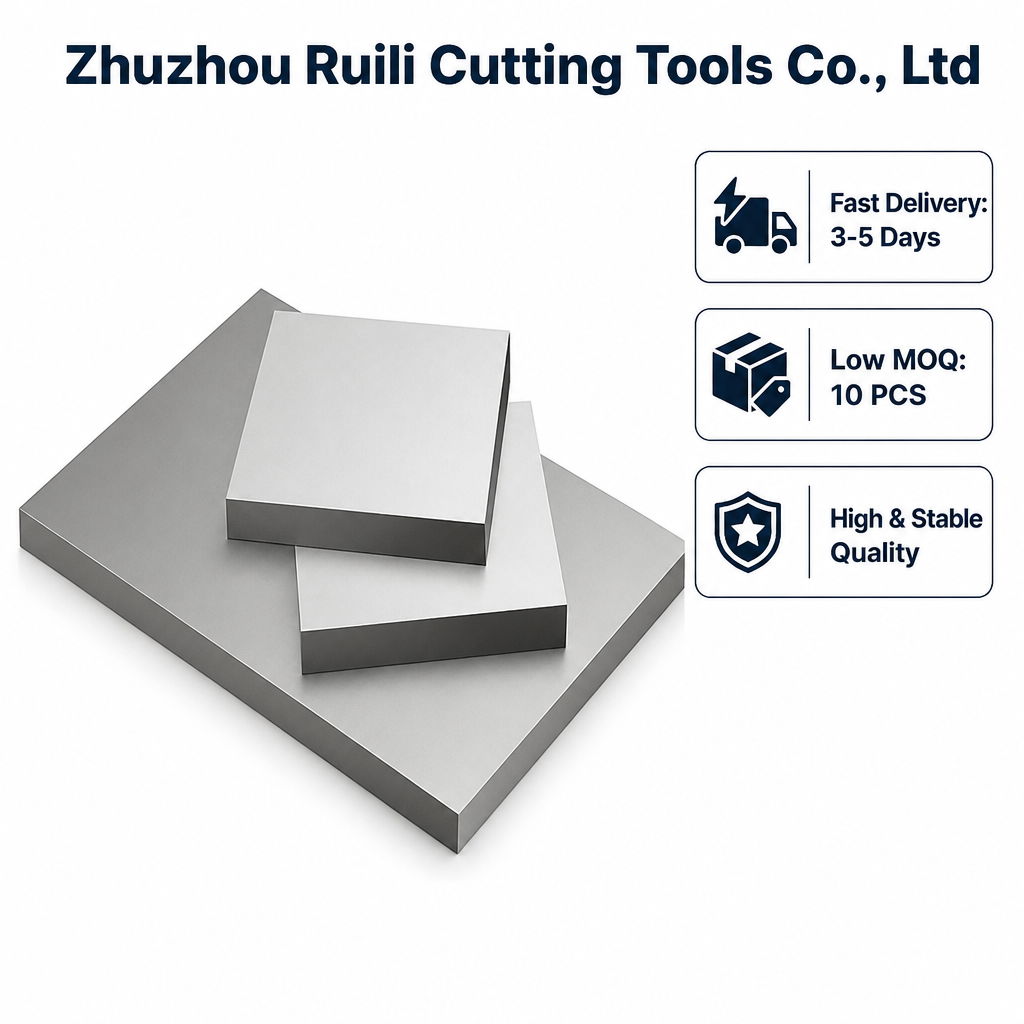
Carbide solid plates are thick, wide and integral flat carbide blanks with large cross-sectional area and sufficient solid thickness. They are specially manufactured for heavy-load wear protection, large-area lining and stress-bearing structural parts.
Key Advantages of Carbide Solid Plates
- Super high load-bearing capacity: Thick solid structure resists strong impact, heavy pressure and mechanical vibration.
- Sufficient wear allowance: Large thickness provides long-term anti-wear performance for harsh scouring environments.
- Strong structural stability: Not easy to deform or crack under long-term cyclic load.
- Wide processing range: Can be cut into irregular shapes, thick gaskets, base plates and heavy-duty mold blanks.
Limitations of Carbide Solid Plates
Solid plates have higher unit material cost. They are too thick and bulky for fine edge cutting tools, and unnecessary usage will cause serious cost redundancy.
4. Essential Differences Between Strips and Solid Plates
The core difference between carbide strips and solid plates lies in structural positioning: strips are for linear tooling, while solid plates are for planar wear-resistant structures.
Structure difference: Carbide strips are slender and thin, focusing on linear dimensional accuracy. Solid plates are wide and thick, focusing on overall structural strength.
Stress resistance difference: Strips resist friction and trimming force; solid plates bear impact pressure and vertical load.
Machining orientation difference: Strips are mainly used for edge sharpening and cutting tool processing. Solid plates are used for surface grinding, grooving and integral shaping of wear parts.
Cost difference: Strips have lower material cost for linear tool production. Solid plates require higher investment but provide stronger protection for heavy-duty equipment.
5. Best Use Cases for Tungsten Carbide Strips
Choose carbide strips when your project requires sharp edges, linear cutting, strip-shaped components and light-to-medium load friction scenarios.
- Woodworking planer blades, trimming cutters and slitting knives
- Metal foil, film and paper strip cutting tools
- Linear wear-resistant guide strips and slide rails
- Scraper blades, ink scrapers and glue cleaning strips
- Thin and narrow custom mold inserts and linear tool blanks
6. Best Use Cases for Tungsten Carbide Solid Plates
Choose carbide solid plates when your project needs large-area wear protection, heavy impact resistance and structural load-bearing functions.
- Mining chutes, hopper liners and heavy anti-wear plates
- Concrete mixing equipment wear liners
- Thick mold base plates and pressure-bearing mold blanks
- Mechanical vibration and impact-resistant structural plates
- Large-area material scouring and heavy friction equipment protection
7. Comprehensive Comparison Table
This table clearly compares carbide strips and solid plates in all application dimensions.
| Comparison Item | Carbide Strips | Carbide Solid Plates |
|---|---|---|
| Structural Feature | Slender, thin, narrow cross-section | Wide, thick, solid integral structure |
| Core Function | Cutting, trimming, linear wear resistance | Impact resistance, planar wear protection, load bearing |
| Impact Resistance | Weak, not for heavy impact | Strong, suitable for harsh impact conditions |
| Machining Focus | Edge sharpening, beveling, fine cutting | Surface grinding, shaping, hole drilling |
| Wear Allowance | Suitable for light uniform friction | Large allowance for long-term heavy scouring |
| Unit Cost | Economical for linear tooling | Higher cost for heavy-duty protection |
| Best Application | Cutting tools & strip wear parts | Equipment liner & structural wear plates |
8. Common Selection Mistakes & How to Avoid Them
Most service life problems are caused by mismatched blank types rather than material quality issues.
Mistake 1: Using strips for heavy impact wear protection. Thin strips will crack or break instantly under heavy particle impact, causing equipment protection failure.
Mistake 2: Using solid plates for cutting blade production. Thick solid plates waste raw materials, increase processing difficulty and cannot form fine sharp edges efficiently.
Mistake 3: Universal blank selection for all scenarios. Linear trimming requires strip edge performance, while planar anti-wear needs solid plate structural strength.
Mistake 4: Ignoring thickness matching. Ultra-thin strips for long-term friction wear out quickly; over-thick solid plates cause cost redundancy.
9. Quick Selection Guide for Engineers
Choose Carbide Strips If: You need to produce cutting blades, trimming tools, scraper parts, linear guide strips and any long & thin functional components with edge requirements.
Choose Carbide Solid Plates If: You need large-area equipment lining, impact-resistant structural parts, thick mold blanks, heavy-load anti-wear plates and planar protection components.
For combined projects with both cutting and wear-resistant requirements, adopt a composite solution: use strips for cutting edges and solid plates for base wear protection.
10. Summary & Custom Carbide Blanks Service
Carbide strips and carbide solid plates serve completely different industrial purposes. Strips excel in edge machining, linear cutting and light friction scenarios with cost advantages and flexible processing performance. Solid plates focus on structural stability, impact resistance and heavy-duty planar wear protection, suitable for harsh industrial environments.
Standardized selection according to functional requirements can effectively avoid tool failure and cost waste. Matching the right blank type is the first step to ensuring stable tool performance and extended service life.
We supply full-series carbide strips and carbide solid plates with complete grades and sizes, supporting custom cutting, edge machining, drilling and shaping processing for various tooling and wear-resistant projects.
Our Carbide Blank Products
Premium Tungsten Carbide Strips
High-precision sintered carbide strips with uniform density, supporting various edge beveling, polishing and cutting processing for cutting tools and linear wear parts.
Carbide Solid Plates
Thick solid carbide wear plates with strong compression and impact resistance, widely used in mining, mixing and material conveying equipment wear protection.
CTA Contact Zone
Free Selection Consultation
📧 Contact Us → /contact-us.htm
Tell us your usage scenario, get professional suggestions on strip or solid plate selection.
Custom Processing & Bulk Order
📧 Contact Us → /contact-us.htm
Factory direct supply of carbide strips and plates, support personalized size and machining customization.
Disclaimer
The selection guidelines in this article are for general industrial reference. Actual service effect is affected by working load, processing technology and carbide grade. Please consult our technical team for targeted blank matching for special working conditions.