Carbide Rod Length Options: Cut-to-Length Service for Custom Tool Manufacturers
- Share
- publisher
- Jane
- Issue Time
- Sep 18,2026
Summary
This professional guide compares ground carbide rods and sintered blank rods in dimensional accuracy, surface quality, machining cost, service performance and application scenarios. It clarifies the core differences between the two carbide blanks, analyzes total production costs, and provides targeted selection advice for tool manufacturers and mechanical processing factories.
Full Article Structure
- 1. Introduction: Why Blank Type Determines Your Tool Production Cost
- 2. What Are Sintered Blank Rods and Ground Carbide Rods?
- 3. Full Cost & Performance Comparison Table
- 4. Pros & Cons of Sintered Blank Rods
- 5. Pros & Cons of Ground Carbide Rods
- 6. Real Production Cases: Which Blank Saves More Cost
- 7. How to Choose According to Your Workshop Conditions
- 8. Common Selection Misunderstandings to Avoid
- 9. Application Scenario Quick Selection Table
- 10. Final Summary & Custom Blank Service
1. Introduction: Why Blank Type Determines Your Tool Production Cost
Tungsten carbide rods are the core blanks for manufacturing solid carbide end mills, drills, reamers and wear-resistant parts. In the carbide tool industry, all rod blanks fall into two categories: sintered blank rods and precision ground carbide rods. Most buyers only focus on the unit price of raw materials, ignoring the hidden costs of grinding time, tool loss, scrap rate and labor consumption.
Sintered blanks look cheaper in raw material cost, but they bring large grinding allowances, unstable geometric accuracy and higher production risks. Ground rods have a higher purchase price, yet they greatly reduce workshop processing pressure and improve finished tool stability and yield.
This article conducts a comprehensive comparison between ground carbide rods and sintered blank rods from accuracy, surface quality, mechanical performance, procurement cost and overall manufacturing cost. It provides practical selection standards for tool manufacturers, helping you avoid blind low-price procurement and achieve real cost optimization.
2. What Are Sintered Blank Rods and Ground Carbide Rods?
Sintered Blank Rod is the original carbide rod after vacuum high-temperature sintering without any outer diameter grinding and straightening treatment. The material completes sintering densification with complete hardness and internal structure, but the surface retains sinter oxide skin. Meanwhile, sintering shrinkage causes unstable diameter tolerance, straightness and roundness, requiring large-scale secondary grinding by customers.
Ground Carbide Rod is processed on the basis of sintered blanks. After precision straightening and diamond wheel outer diameter grinding, the sinter skin is completely removed, and geometric dimensions including diameter tolerance, straightness and roundness are strictly controlled. The finished ground rod features smooth surface, stable precision and extremely small grinding allowance, which can be directly used for high-precision tool grinding.
It is worth emphasizing that the two blanks adopt the same WC-Co sintering process and material formula. There is no difference in inherent hardness, density and TRS mechanical properties. The only gap lies in post-processing precision and surface quality.
3. Full Cost & Performance Comparison Table
The table below intuitively shows the core differences between sintered blank rods and ground carbide rods in all dimensions.
| Comparison Item | Sintered Blank Rod | Ground Carbide Rod | Actual Production Impact |
|---|---|---|---|
| Diameter Tolerance | +0.3~+0.7mm large deviation | -0.003~-0.03mm precise control | Ground rods ensure consistent clamping accuracy |
| Straightness & Roundness | Uncorrected sinter bending deformation | Straightened and precision calibrated | Sintered blanks easily cause tool run-out |
| Surface Condition | With sinter oxide skin, rough surface | Smooth mirror grinding, no oxide layer | Sinter skin will cause tool edge defects |
| Raw Material Unit Cost | Low | Medium to High | Sintered blanks have lower procurement price |
| Workshop Grinding Load | Heavy, long processing time | Light, fast finishing grinding | Ground rods greatly improve production efficiency |
| Grinding Wheel Loss | High consumption | Low consumption | Sintered blanks increase accessory cost |
| Finished Product Scrap Rate | High, easy to retain deformation | Low, stable blank benchmark | Ground rods reduce production loss |
| Applicable Products | Non-precision wear parts, heavy grinding blanks | End mills, drills, reamers, micro tools | Precision tools must use ground rods |
4. Pros & Cons of Sintered Blank Rods
Advantages
- Ultra-low raw material purchase cost, effectively reducing upfront material procurement expenditure.
- Strong dimensional flexibility: one specification of sintered blank can be ground into multiple different finished diameters, reducing inventory pressure.
- Suitable for large-batch rough processing and non-precision wear-resistant part production scenarios.
Disadvantages
- Large geometric deformation and poor consistency, which cannot meet the precision requirements of rotary cutting tools.
- Serious sinter oxide skin, incomplete removal will lead to tool edge chipping and shortened service life.
- Heavy grinding workload consumes a large number of grinding wheels and machine tool resources, resulting in low production efficiency.
- High hidden scrap risk, residual bending deformation will cause tool run-out and processing vibration.
5. Pros & Cons of Ground Carbide Rods
Advantages
- Strictly controlled tolerance and straightness, no bending deformation, effectively avoiding finished tool run-out problems.
- Complete removal of sinter oxide skin, smooth and uniform surface, ensuring tool edge integrity and stability.
- Minimal grinding allowance, greatly saving grinding time, reducing wheel loss and power consumption.
- High blank consistency, stable finished tool quality, low scrap rate, suitable for high-precision tool mass production.
Disadvantages
- Higher unit price due to additional supplier straightening and precision grinding processes.
- Fixed finished diameter, requiring multiple specifications of inventory for diversified tool production.
- High-precision ground rods have higher costs, not suitable for ultra-low-precision ordinary parts.
6. Real Production Cases: Which Blank Saves More Cost
Case 1: Precision Tool Factory Producing Micro Drills
A micro tool manufacturer used sintered carbide blanks to save material costs. In actual production, the blank bending deformation could not be completely removed by grinding, resulting in frequent micro-drill breakage and a scrap rate of more than 15%. After switching to high-precision ground rods, the scrap rate dropped below 2%, tool stability was greatly improved, and the overall comprehensive production cost was reduced by 28% despite the higher blank price.
Case 2: Large Wear-Resistant Parts Processing Plant
A factory focusing on custom carbide wear parts has sufficient grinding equipment and abundant processing capacity. All products require large-scale shaping and grinding. They insist on using sintered blank rods. Relying on self-owned grinding resources, they avoid high grinding fees of ground rods, realizing real low-cost mass production, which is the most cost-effective choice for their production mode.
7. How to Choose According to Your Workshop Conditions
The core of blank selection is to match your own production capacity and product positioning, not simply pursue low price or high precision.
- Choose Ground Carbide Rods if you produce precision cutting tools such as end mills, drills and reamers, have insufficient grinding capacity, or require low scrap rate and stable batch quality.
- Choose Sintered Blank Rods if you produce non-precision wear parts, have sufficient idle grinding machines, and need flexible size conversion to control inventory costs.
For most professional tool-making enterprises focused on finished tool quality and delivery efficiency, precision ground rods are the optimal long-term solution.
8. Common Selection Misunderstandings to Avoid
Many procurement and production teams have wrong cognition when selecting carbide blanks, resulting in increased hidden costs.
First misunderstanding: Low raw material price equals low production cost. Sintered blanks transfer the grinding cost and scrap risk to the buyer’s workshop, which often leads to higher overall expenditure.
Second misunderstanding: Grinding can completely eliminate all blank deformation. Excessive initial bending of sintered blanks will leave axis deviation after grinding, affecting tool rotation accuracy.
Third misunderstanding: The same material formula means the same tool performance. Unpolished sinter skin and unstable blank consistency will directly reduce the service life of finished tools.
Fourth misunderstanding: All carbide tools can use sintered blanks. Micro tools and high-precision finishing tools have extremely low error tolerance, and sintered blanks cannot meet the production standard.
9. Application Scenario Quick Selection Table
Quickly match the appropriate carbide blank type according to your production project.
| Production Scenario | Recommended Blank Type | Core Reason |
|---|---|---|
| Micro drill, precision reamer, tiny tool blank | High-precision Ground Rod | Zero tolerance for deformation, ensure tool yield |
| Standard end mill, CNC cutting tool mass production | Standard Ground Rod | Balance cost and precision, stable batch quality |
| Large-size carbide wear parts, custom shaping parts | Sintered Blank Rod | Allow large grinding allowance, save raw material cost |
| Workshop with sufficient grinding equipment & multi-size processing | Sintered Blank Rod | Flexible size conversion, reduce inventory cost |
| Short delivery cycle & high finished product qualification rate | Ground Carbide Rod | Reduce grinding workload and shorten production cycle |
10. Final Summary & Custom Blank Service
Sintered blank rods and ground carbide rods have consistent material properties, and the core difference lies in post-processing precision and surface quality. Sintered blanks are low in raw material price but have heavy processing burden and high hidden risks, suitable for non-precision products and workshops with sufficient grinding capacity. Ground rods have a slight premium in unit price, but they greatly optimize production efficiency, reduce scrap loss and ensure stable finished tool performance, which is the mainstream choice for professional carbide tool manufacturers.
Reasonable blank selection should comprehensively consider product precision requirements, workshop equipment capacity, delivery cycle and comprehensive production cost, instead of single-mindedly pursuing low raw material prices.
We provide full-series sintered blank rods and standard/high-precision ground carbide rods, and support custom grinding allowance, special tolerance and special specification blank customization to meet different production needs of customers.
Our Carbide Rod Product Line
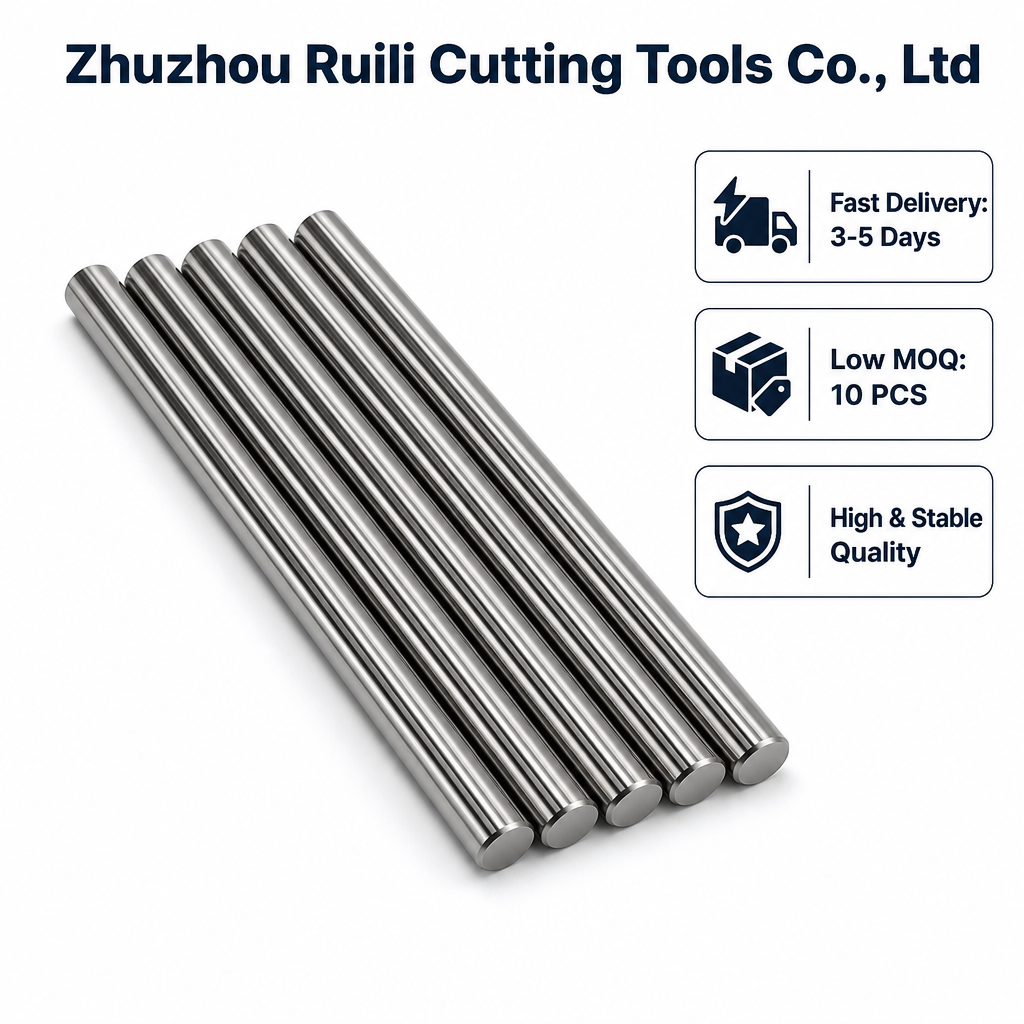
Precision Ground Carbide Rods
Standard and high-precision ground rods with strict tolerance and straightness control, specially used for end mills, drills, reamers and various high-precision cutting tool blanks.
CTA Contact Zone
Technical Consultation & Custom Orders
📧 Contact Us → /contact-us.htm
Provide your product type, precision requirements and workshop conditions, we provide free professional blank selection suggestions and formal quotations.
Bulk Procurement & Long-term Cooperation
📧 Contact Us → /contact-us.htm
Support bulk customized orders and long-term supply contracts for tool factories and industrial distributors, with stable batch quality and competitive prices.
Disclaimer
The content of this blog is for industry reference only. The actual comprehensive cost is affected by equipment status, labor cost, processing technology and management level. It is recommended to select suitable carbide blanks according to actual production conditions. Please consult our technical team for professional guidance before bulk procurement.