Carbide Die Blank: Pre-sintered Blank vs Finished Machined Die
- Share
- publisher
- Jane
- Issue Time
- Sep 19,2026
Summary
This article clarifies the core differences between pre-sintered carbide blanks and finished machined carbide dies. It compares material characteristics, machining performance, cost, lead time and application scenarios, helping tool manufacturers and processors choose between semi-finished blanks and finished dies for mold making, tooling production and custom carbide processing.
Full Article Structure
- 1. Introduction: What Are Carbide Die Blanks & Finished Dies
- 2. What Is Pre-sintered Carbide Blank? Features & Pros & Cons
- 3. What Is Finished Machined Carbide Die? Features & Pros & Cons
- 4. Core Differences: Pre-sintered Blank vs Finished Die
- 5. Machining Performance & Processing Difficulty Comparison
- 6. Suitable Applications for Pre-sintered Blanks
- 7. Suitable Applications for Finished Machined Dies
- 8. Comprehensive Parameter Comparison Table
- 9. How to Choose: Blank or Finished Die for Your Project
- 10. Summary & Custom Carbide Die Solutions
1. Introduction: What Are Carbide Die Blanks & Finished Dies
Tungsten carbide dies are widely used in cold heading, wire drawing, tube forming, stamping and custom tooling industries. When purchasing carbide tooling, manufacturers always face a critical choice: pre-sintered carbide blanks or fully finished machined carbide dies. Many buyers confuse these two product forms, resulting in increased processing costs, delayed lead times or unsatisfactory final precision.
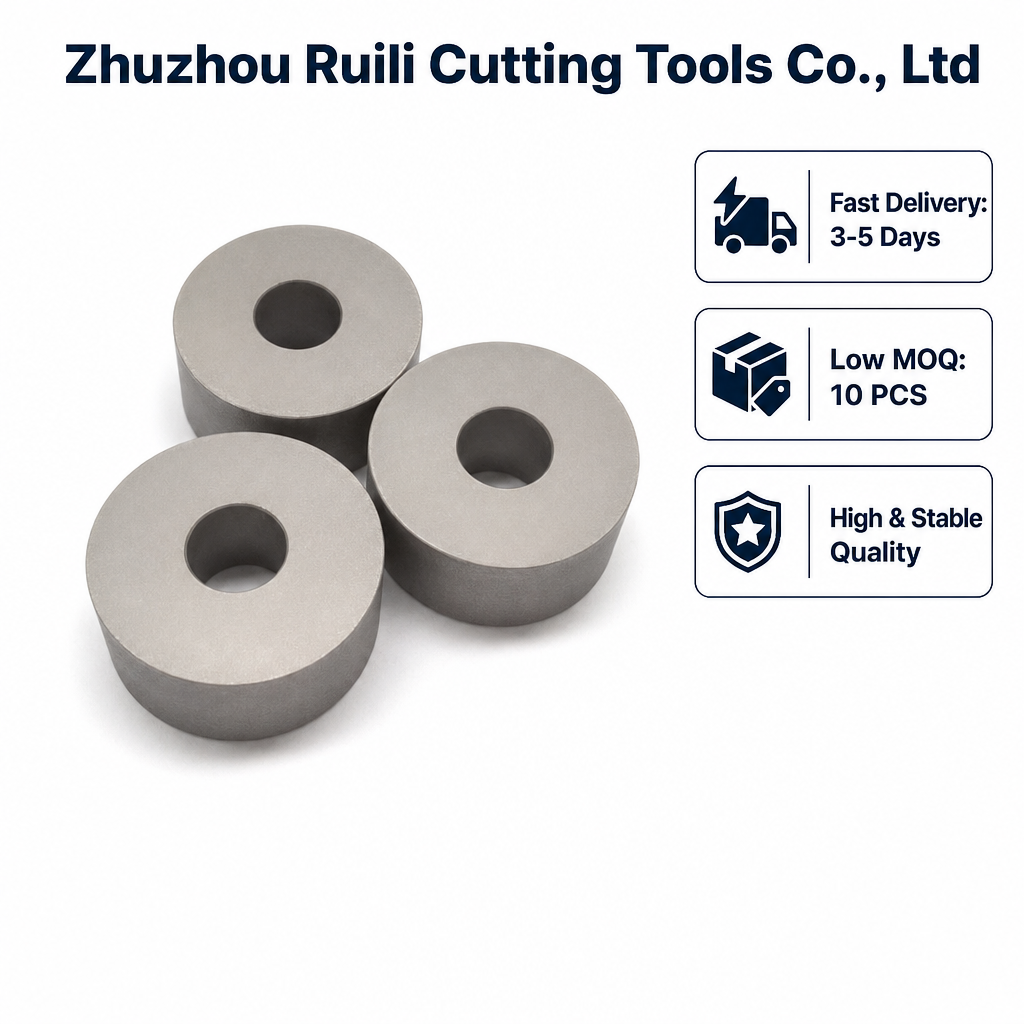
Pre-sintered blanks are semi-finished carbide products with basic shaping but no precision grinding, hole machining or surface finishing. In contrast, finished machined carbide dies are fully processed with precise dimensions, qualified surface roughness and complete structural features, ready for direct installation and use.
The two types differ greatly in hardness status, machining allowance, cost, delivery cycle and applicable scenarios. This article elaborates on their core characteristics, compares advantages and disadvantages, and provides accurate selection guidelines for mold factories, tooling processors and fastener manufacturing enterprises.
2. What Is Pre-sintered Carbide Blank? Features & Pros & Cons
Pre-sintered carbide blanks are semi-finished workpieces after low-temperature pre-sintering treatment. The carbide powder is pressed and preliminarily sintered to form a stable blank shape, but without high-temperature final sintering and precision grinding. The material maintains low hardness and good machinability for secondary processing.
Advantages of Pre-sintered Carbide Blanks
- Easy secondary machining: Low pre-sintered hardness allows turning, drilling, milling and hole carving with common tools, no need for professional diamond grinding equipment.
- High flexibility: Suitable for non-standard, complex and special-shaped die structures, supporting personalized secondary design and modification.
- Low processing loss: Users can reserve reasonable machining allowance according to actual needs, avoiding material waste of finished dies.
- Short blank delivery cycle: Standard size blanks are in stock, supporting rapid procurement and emergency processing.
- Low comprehensive cost for custom projects: Ideal for small-batch and customized die development to reduce mold opening fees.
Limitations of Pre-sintered Blanks
- Requires complete secondary processing, including fine grinding, hole finishing and surface polishing.
- Needs professional processing technology to avoid deformation, size deviation and surface defects during finishing.
- Cannot be used directly after delivery, requiring additional working days for post-processing.
3. What Is Finished Machined Carbide Die? Features & Pros & Cons
Finished machined carbide dies are fully processed final products. After formal high-temperature sintering, precision CNC grinding, inner hole finishing, edge treatment and surface polishing, the dies reach standard industrial tolerance and surface finish, supporting direct installation and production.
Advantages of Finished Machined Dies
- Ready-to-use: Complete dimensions, precise tolerance and qualified surface quality, no secondary processing required.
- Stable performance: Standard high-temperature sintering ensures uniform carbide density, stable hardness and excellent wear resistance.
- High dimensional consistency: Batch production with unified processing standards, zero difference between individual products.
- No processing threshold: Suitable for factories without precision carbide grinding equipment.
- Stable service life: Professional finishing eliminates internal stress and surface micro-defects, extending die working cycle.
Limitations of Finished Machined Dies
- Fixed size and structure, difficult to modify secondary processing.
- Higher unit price due to complete sintering and precision processing procedures.
- Longer production cycle for non-standard finished dies.
4. Core Differences: Pre-sintered Blank vs Finished Die
The essential difference between pre-sintered blanks and finished dies lies in the sintering state and processing completion, which determines their entire application logic.
Sintering status difference: Pre-sintered blanks are semi-sintered with loose internal structure and low hardness, reserved for secondary shaping. Finished dies are fully sintered with dense internal structure, reaching the standard hardness and toughness of industrial carbide tools.
Machining attribute difference: Pre-sintered blanks belong to semi-finished raw materials, focusing on processing feasibility. Finished dies belong to terminal tooling products, focusing on use stability and precision.
Performance difference: Pre-sintered blanks cannot bear formal extrusion, friction and impact load. Finished dies have qualified wear resistance, compression resistance and fatigue resistance for long-term industrial production.
Modification difference: Pre-sintered blanks support arbitrary shaping and structural adjustment. Finished dies are basically unmodifiable, and secondary cutting will easily cause edge chipping and cracking.
5. Machining Performance & Processing Difficulty Comparison
Pre-sintered carbide blanks have extremely low processing difficulty, which is the biggest advantage for custom die manufacturers. Ordinary CNC machine tools can complete drilling, grooving, contour cutting and hole shaping without diamond grinding tools, greatly reducing processing threshold and equipment investment.
After secondary finishing and final sintering, blanks can achieve the same hardness and mechanical performance as integral finished dies. This processing method is very suitable for complex special-shaped dies that cannot be directly formed by finished mold opening.
In contrast, finished carbide dies are ultra-hard and dense. Any secondary modification requires professional diamond grinding and ultra-precision equipment. Ordinary cutting tools cannot process finished carbide dies, and improper operation will lead to tool damage and die scrapping.
6. Suitable Applications for Pre-sintered Blanks
Pre-sintered carbide blanks are the best choice for customized, small-batch and complex structural die projects.
- Custom special-shaped cold heading dies and non-standard stamping dies.
- Complex inner hole structural drawing dies and multi-groove forming dies.
- Small-batch trial production and new mold development projects.
- Enterprises with self-processing and self-grinding capabilities.
- Special tooling with irregular outlines and personalized installation positions.
7. Suitable Applications for Finished Machined Dies
Finished machined carbide dies are more suitable for standardized, mass-produced and high-precision industrial scenarios.
- Standard wire drawing dies, tube drawing dies and conventional cold heading dies.
- Mass production fastener tooling with fixed sizes and unified standards.
- High-precision production scenarios requiring strict tolerance control.
- Factories without carbide precision processing equipment and technical personnel.
- Stable batch production projects that do not require structural modification.
8. Comprehensive Parameter Comparison Table
This table intuitively shows the differences between pre-sintered carbide blanks and finished machined carbide dies in all dimensions.
| Comparison Item | Pre-sintered Carbide Blank | Finished Machined Carbide Die |
|---|---|---|
| Sintering Status | Semi-sintered, unfinished density | Full high-temperature sintering, dense structure |
| Hardness Level | Low, easy for cutting processing | Standard industrial high hardness |
| Machining Difficulty | Low, common machine tools processable | High, only diamond grinding processable |
| Structural Flexibility | Strong, support custom shaping | Fixed structure, difficult to modify |
| Usage Method | Need secondary finishing | Direct installation and use |
| Production Precision | Depends on secondary processing | Factory standardized high precision |
| Delivery Cycle | Short for standard blanks | Longer for custom finished products |
| Unit Cost | Low blank cost | Higher with full processing fee |
| Best Application | Custom & complex die development | Standard mass production tooling |
9. How to Choose: Blank or Finished Die for Your Project
Enterprises can quickly select products according to processing capacity and project attributes.
Choose Pre-sintered Blanks If: You need non-standard special-shaped structures, have independent grinding and processing capabilities, carry out new mold trial production and small-batch customization, or want to reduce mold opening and procurement costs.
Choose Finished Machined Dies If: You need standard-size dies for mass production, pursue stable precision and consistent batch quality, have no professional carbide processing equipment, or require fast on-site installation and production.
For large-scale standardized production, finished dies ensure stability; for personalized customized tooling, pre-sintered blanks maximize flexibility and cost performance.
10. Summary & Custom Carbide Die Solutions
Pre-sintered carbide blanks and finished machined carbide dies serve completely different production needs. Pre-sintered blanks feature flexible processing, low threshold and strong customization, suitable for complex non-standard die development and small-batch trial production. Finished dies feature high precision, stable performance and ready-to-use advantages, perfectly matching standardized mass production scenarios.
There is no absolute good or bad between the two. The optimal selection depends on enterprise processing equipment, production batch and product standardization. Reasonable matching can effectively control costs, shorten development cycle and improve production efficiency.
We supply full-series pre-sintered carbide blanks and finished precision machined carbide dies, supporting personalized size, grade and structural customization for various mold and tooling industries.
Our Carbide Die Products
Pre-sintered Carbide Blanks
Multiple carbide grades of pre-sintered blanks with stable semi-finished hardness, easy for secondary milling, drilling and grinding, ideal for custom die processing and new product development.
Learn More → /custom-carbide-parts.htm
Finished Machined Carbide Dies
High-precision finished drawing dies, cold heading dies and forming dies, fully sintered and finely polished, ready for direct industrial production.
CTA Contact Zone
Product Selection & Free Consultation
📧 Contact Us → /contact-us.htm
Tell us your processing needs and equipment conditions, get free blank or finished die matching suggestions.
Custom Processing & Bulk Order
📧 Contact Us → /contact-us.htm
Support custom blank sizing and finished die precision processing, factory direct wholesale price.
Disclaimer
The selection guidelines in this article are for general industrial reference. Actual processing effect and product performance are affected by processing technology, equipment precision and carbide grade. Please consult our technical team for targeted solutions for special working conditions.